Tuesday, January 31, 2006

Believe it: Hamas target is Israel

NY Daily News:

While it is probably true that Hamas won the recent Palestinian elections not because it promised to wipe out Israel, but because it promised to pick up the garbage in Gaza City, it is also true that the prospect of increased violence did not deter the average Palestinian from voting for Hamas. History has seen this sort of thing before. The rule - the only rule - is to take zealots at their word.

If you would have asked a random German in, say, 1932 if he was voting for the murder of Jews, he would have said, "Nein!" What he really wanted was an end to the brawling in the streets and a big thumbs-up to traditional German culture.

I saved for this paragraph any reference to Hitler so as to postpone the reflexive outburst of "Nothing can be compared to the Nazis!" Normally, I agree, and I usually shy from such comparisons. But I am not likening Hamas or Islamist militancy to Nazism, I am only likening the mind of one sort of zealot to another.

They mean what they say. For the Nazi, it was all in their bible, "Mein Kampf," and in their rallies and speeches. It took some effort to overlook their stated intentions, but a considerable number of people managed to do so and later professed shock at what happened. They looked into the abyss, saw nothing that concerned them personally - and went back to sleep.

In due course we will be told that what Hamas has been insisting on for years - the utter destruction of Israel - is not really a serious goal. Hamas will be forced to moderate by the reality of governing. As for its truculent anti-Semitism - not to be confused in this case with anti-Zionism - it will be dismissed as without consequence. Hamas will have to deal with reality - and Israel, in the region, is the mightiest reality of them all. Yasser Arafat came to understand that.

But Arafat's Fatah movement was secular and nationalistic. Hamas, on the other hand, can be traced back to the Muslim Brotherhood and its 1928 declaration: "The Koran Is Our Constitution." It gleefully sends people off to their death as suicide bombers, spackling the walls of Tel Aviv restaurants with the flesh of the innocent while assuring the bombers a place in paradise. This is terrifying. That is the whole idea.

The continual mistake of the Bush administration is to think, based on not much thinking to begin with, that people are people - pretty much the same the world over. This is why the President extols democracy. It must be what everyone wants because it is what everyone here wants. But Toto knows the truth. The Middle East is not Kansas.

The leaders of Hamas brim with the word of God and the certainty of their cause. From here on they will lie about their ultimate aim and smilingly assure us that what they have always said they no longer mean. All over the world, people will believe them and urge the U.S. and Israel to do the same. Take my word for this. Anyone can see the future. It's all in the past.

Richard Cohen, a syndicated columnist for the Washinton Post, is a graduate of Far Rockaway High School and attended Hunter, NYU and Columbia. He was a four-time honorable-mention winner in Pulitzer Prize competitions (he doesn't know if that's a record, but says it's his personal best). Cohen splits his time between Washington D.C. and New York City.

Air Security's latest "F"

NY Post:

The latest bin Laden tape was a grim reminder that terrorists are still probing for our weaknesses. So last month's 9/11 Commission report giving airline passenger-screening an "F" is a kick to the gut.
Why do our airports remain vulnerable? It's not lack of resources: The Transportation Security Administration (TSA) earned that "F" despite spending nearly its entire $5.5 billion budget last year on passenger and baggage screening.
Nor is screening the only problem area. Access to planes and the tarmac, either through the airport fence or by thousands of on-airport workers, remains a weak point. We still don't check most carry-on luggage for explosives. And the security measures we've added — baggage-inspection machines, more checkpoints — make for more crowds, a likely suicide-bombing target.
Reason Foundation's year-long assessment of airport security concluded that these holes, and others, are due to three fundamental problems with TSA.

First, TSA assumes all passengers are equally likely to be a threat. So all checked bags get the same costly screening; we all stand in the same endless lines, take off our shoes, etc.

Second, TSA is grossly over-centralized and unable to handle the wide diversity of circumstances at 450 different airports. Rep. John Mica (R-Fla.), the chairman of the House aviation subcommittee, calls it a "Soviet-style, command-and-control approach" that "has been unable to match the changing requirements."

Third, as both the provider of airport screening and its regulator, TSA has a built-in conflict of interest that allows it to grade and monitor its own performance. Here's the kind of thing that leads to: Shortly after it's creation, TSA paid a company to recruit new screeners; the taxpayers wound up spending $143,432 in recruitment costs for each screener — each screener — in the terrorism hotbed of Topeka, Kan. A bungling bureaucracy shouldn't police itself.

We can, and must, do better.

TSA should be reconceived as a rule-setter and enforcer, and get out of the business of providing security services. Individual airports (which already carry out other security functions, such as perimeter protection) should be given control of security, with strict TSA oversight and auditing. And our policies on airport security should become thoroughly risk-based, with more resources devoted to high-risk passengers and situations and less devoted to low-risk ones.

Israeli airports and 19 of the 20 busiest airports in Europe all use this risk-based airport-security model. Their governments don't provide screening services, but instead set and enforce strict standards that airports and their contractors must meet and adhere to — with severe penalties for failures.

A risk-based system would focus more resources on potential terrorists — where they should be focused. A computer program had flagged more than half the 9/11 terrorists as risks — but they weren't then exposed to tough enough questioning or security.

We need to concentrate time and resources on the highest threats — and toddlers and terrorists are not equal threats.

The forthcoming Registered Traveler program (scheduled for the summer), under which frequent flyers can opt to go through a background check and security clearance to gain access to fast-lane processing with a biometric I.D. card, is an important first step. This is one way to reduce the haystack, to better find the needles.

Sure, a terrorist could try to roll the dice and infiltrate the Registered Traveler system. But ask yourself this — are terrorists more likely to volunteer themselves for in-depth background checks and fingerprinting to get a Registered Traveler card (where they'll still have to go through security at the airport) or simply take their chances in the regular lanes, knowing that most carry-on bags and passengers don't even get screened for explosives?

Our reaction to 9/11 created an air-security policy that doesn't examine relative risks, costs or benefits. And that system is failing miserably. It shouldn't take another attack to make us fix its fundamental flaws.

Robert Poole is director of transportation studies at Reason Foundation and author of the new study "Airport Security: Time for a New Model." He was a member of the Bush-Cheney transition team in 2000-01 and advised the White House Domestic Policy Council and several members of Congress on airport security following the 9/11 terrorist attacks.

Palestinians fret about threatened aid cut off

Reuters:

Saleh Billo, a father of five who teaches at a Palestinian Authority school, is not sure where his next pay cheque will come from.

"If my salary stops then I will have a hard time buying food for my children," said Billo, one of 140,000 Palestinian Authority employees waiting anxiously to see whether the United States and the European Union will slash aid in response to last week's election victory by Hamas.

"I don't know what I will do. It will be disastrous for us," Billo, 48, told Reuters.

The Palestinian Authority is the biggest single employer in the West Bank and the Gaza Strip. But it is nearly bankrupt and highly dependent on foreign aid to stay afloat.

Last year, it received 500 million euros ($612 million) from the European Union and it was expecting a similar amount this year, as well as over $200 million from the United States.

Israel also transfers about $500 million annually of taxes it collects on behalf of the Palestinian Authority.

But that money could soon dry up.

Israeli officials said on Tuesday that tax payments were likely to be frozen following the election victory of Hamas, which is sworn to Israel's destruction.

On Monday, the United States and other major powers said Hamas must reject violence and recognise the state of Israel or risk losing vital aid when it forms a new Palestinian government.
Hamas, which has killed hundreds of Israelis in a suicide bombing campaign since a Palestinian uprising began in 2000, has so far rejected international threats to cut off aid as "blackmail".

In a bid to keep aid flowing, Hamas leaders have suggested they might not have representatives in the government but rather put unaffiliated technocrats in the cabinet.

ECONOMIC SHOCK WAVES

Crunch time for Palestinian Authority employees, including more than 60,000 security men, will come on Wednesday when Israel is due to transfer about $55 million in taxes to the Authority.
If the transfer does not go ahead then the Palestinian Authority will probably not have enough money to pay salaries.

Palestinian Minister of Economic Affairs Mazen Sonnoqrot said withholding the money would be "irresponsible and grave".

"This is a message to our employees telling them 'you should feel economically insecure'," he said.

The international community does not want to assist a government led by Hamas -- which appears on the U.S. and EU list of terror groups.

But the quandary for the international community is that failure to send aid to the Palestinian Authority could cause a collapse of the local economy, resulting in chaos.

"If I get to the point where I can't feed my children then I might join a gang of brigands," said Abu Awad, a security man with two children from the West Bank city of Jenin.

Monday, January 30, 2006

Quartet gives Hamas time

Daily Telegraph:

The militant Palestinian group Hamas has won time from a wary European Union, Russia and the United States to wipe the blood off its hands, renounce violence and recognise Israel's right to exist before it forms the next Palestinian government.

Meeting in London in the wake of Hamas's stunning victory in last week's Palestinian elections, the diplomatic Quartet on Middle East peace – which also includes the United Nations – pledged to keep money flowing into Palestinian leader Mahmud Abbas's interim caretaker administration.

"We do believe that Abu Mazen (Abbas) needs to be supported," US Secretary of State Condoleezza Rice said, ensuring that funds would be available to pay for Palestinian police officers and civil servants.

But the Quartet warned that the Palestinians' critical lifeline of foreign aid could be lost in the longer term unless Hamas – perpetrator of deadly suicide bomb attacks on Israelis – abandoned violence, recognises Israel and embraces the diplomatic "roadmap" to peace.
That blueprint to peace envisions an independent Palestinian nation living side by side with the Jewish state.

The Hamas movement swiftly rejected the quartet's demands which the radical group said served only Israel's interests.

"The conditions posed by the quartet constitute pressure which serves the interests of Israel and not the Palestinian people," Hamas MP and spokesman Mosheer al-Masri said.

The quartet, in a late-night statement said they believed "that the Palestinian people have the right to expect that a new government will address their aspirations for peace and statehood".

But the statement stressed that "future assistance to any future government would be reviewed by donors against the government's commitment to the principles of non-violence, recognition of Israel and acceptance of previous agreements and obligations, including the roadmap."

With three months likely to pass before a new Palestinian government is formed, the quartet's stance amounts to a watch period for Hamas to change if it wants to be accepted as a serious partner in the peace process.

A senior Hamas leader, Ismail Haniya, appealed earlier yesterday in Gaza City to the quartet to meet the radical Islamist organisation for "a dialogue without preliminary conditions and in a spirit of neutrality".

Israel meanwhile declared that it has decided to freeze funds to the Palestinian Authority, fearing the money could end up being used to attack and kill Israeli citizens.

Two million shekels ($46.82 million) – drawn mainly from sales tax revenues and customs duties on Palestinian-bound goods passing through Israel – were due to be handed over to the Palestinian Authority tomorrow.

Anarchy and chaos continue in Gaza

Reuters:

A military leader of Palestinian militant group Hamas was wounded in a drive-by shooting in the Gaza Strip on Monday, local witnesses and medics said.

Khaled Abu Anza, a local leader of Hamas's armed wing was seriously wounded in the attack, according to medics. Another man travelling with him was also hurt, they said.

No claim was made for the shooting, but local Hamas leaders blamed rival group Fatah as responsible for the attack.

Terror Chief Taunts Bush


CBS/AP:

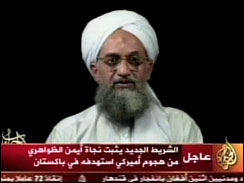
Al Qaeda's deputy leader Ayman al-Zawahiri called President Bush a "butcher" and a "failure" in a videotape aired on Arab television Monday, his first appearance since an American airstrike that targeted him this month in Pakistan.

Al-Zawahiri, shown in the video wearing white robes and a white turban, said the Jan. 13 airstrike killed "innocents" and said the United States had ignored an offer from al Qaeda leader Osama bin Laden for a truce. The video was aired on the Arab news network Al-Jazeera.

"Butcher of Washington, you are not only defeated and a liar, but also a failure. You are a curse on your own nation," he said, referring to Mr. Bush. "Bush, do you know where I am? I am among the Muslim masses."

The airstrike hit a building in the eastern Pakistan village of Damadola, killing four al Qaeda leaders. Thirteen villagers were also killed in the strike, angering many Pakistanis.

"My second message is to the American people, who are drowning in illusions. I tell you that Bush and his gang are shedding your blood and wasting your money in frustrated adventures," he said, speaking in a forceful and angry voice.

"The lion of Islam, Sheik Osama bin Laden, may God protect him, offered you a decent exit from your dilemma. But your leaders, who are keen to accumulate wealth, insist on throwing you in battles and killing your souls in Iraq and Afghanistan and – God willing – on your own land."

There was no immediate comment from the White House on the new Zawahiri tape, CBS News correspondent Mark Knoller reports.

The video came in the wake of a Jan. 19 audiotape by bin Laden in which he warned that al Qaeda is preparing attacks in the United States but offered a truce "with fair conditions" to build Iraq and Afghanistan.

The tape – also aired on Al-Jazeera – was the first message from bin Laden in more than a year.

2,000-Year-Old Judean Date Seed Growing Successfully

Arutz Sheva:

A 2,000 year old date seed planted last Tu B’Shvat has sprouted and is over a foot tall. Being grown at Kibbutz Ketura in the Negev, it is the oldest seed to ever produce a viable young sapling.

The Judean date seed was found, together with a large number of other seeds, during archaeological excavations carried out close to Massada near the southern end of the Dead Sea, the last Jewish stronghold following the Roman destruction of the Holy Temple. The age of the seeds was determined using carbon dating, but has a margin of error of 50 years – placing them either right before or right after the Massada revolt.

The seeds sat in storage for thirty years until Elain Solowey of the Arava Institute for Environmental Studies was asked to attempt to cultivate three of them. Solowey spoke with Israel National Radio's Yishai Fleisher and Alex Traiman about reviving the ancient date palm.

Solowey, who raised the plant, has grown over one hundred rare and almost extinct species of plants. Together with Hadassah Hospital’s Natural Medicine Center, she seeks to use the plants listed in ancient remedies to seek effective uses for modern medical conditions. The Judean date has been credited with helping fight cancer, malaria and toothaches. Solowey was skeptical about the chances of success at first, but gave it a try. “I treated it in warm water and used growth hormones and an enzymatic fertilizer extracted from seaweed in order to supplement the food normally present in a seed,” she said.

As this year’s Tu B’Shvat (The 15th of the Jewish month of Shvat, the Jewish new year for trees) approaches, the young tree that sprouted from one of the three seeds now has five leaves (one was removed for scientific testing) and is 14 inches tall. Solowey has named it Metushelah (Methusaleh), after the 969-year-old grandfather of Noah, the oldest human being recorded in the Torah.

Solowey said that although the plant’s leaves were pale at first, the young tree now looks “perfectly normal.” The Judean palms once grew throughout the Jordan Valley, from Lake Kinneret (the Sea of Galilee) to the Dead Sea. Those from Jericho, at the northern end of the Dead Sea, were of particularly notable quality. Though dates are still grown widely in the Jordan Valley, the trees come mostly from California.

The Judean date palm trees are referred to in Psalm 92 (“The righteous shall flourish like the palm tree…”). The tree was also depicted on the ancient Jewish shekel and now appears on the modern Israeli 10-shekel coin.

It is too early to tell the sex of the tree, but if it is female, it is supposed to bear fruit by 2010, after which it can be propagated to revive the Judean date palm species altogether. “It is a long road to our being able to eat the Judean date once again,” Solowey said, “but there is the possibility of restoring the date to the modern world.”

U.S. Underestimated Hamas Strength

Here:

Secretary of State Condoleezza Rice acknowledged Sunday that the United States had failed to understand the depth of hostility among Palestinians toward their longtime leaders. The hostility led to an election victory by the militant group Hamas that has reduced to tatters crucial assumptions underlying American policies and hopes in the Middle East.

"I've asked why nobody saw it coming," Ms. Rice said, speaking of her own staff. "It does say something about us not having a good enough pulse."

Immediately after the election, Bush administration officials said the results reflected a Palestinian desire for change and not necessarily an embrace of Hamas, which the United States, Israel and the European Union consider a terrorist organization sworn to Israel's destruction. But Ms. Rice's comments seemed to reflect a certain second-guessing over how the administration had failed to foresee, or factor into its thinking, the possibility of a Hamas victory.

Indeed, Hamas's victory has set off a debate whether the administration was so wedded to its belief in democracy that it could not see the dangers of holding elections in regions where Islamist groups were strong and democratic institutions weak.

"There is a lot of blame to go around," said Martin Indyk, a top Middle East negotiator in the Clinton administration, referring to Mahmoud Abbas, the Palestinian president, and his Fatah party. "But on the American side, the conceptual failure that contributed to disaster was the president's belief that democracy and elections solve everything."

Ms. Rice pointed out that the election results surprised just about everyone. "I don't know anyone who wasn't caught off guard by Hamas's strong showing," she said on her way to London for meetings on the Middle East, Iran and other matters. "Some say that Hamas itself was caught off guard by its strong showing."

With increasing vehemence in the last few days, administration officials have defended their decision to back Mr. Abbas with American aid and to rebuff Israel when it warned that the election should not be held as long as Hamas participated while refusing to lay down its arms. Those officials continue to lay most of the blame on Mr. Abbas for not offering a positive alternative to Hamas.

American officials say they were never comfortable with Mr. Abbas's decision that the elections be held without the disarmament of Hamas, but they went along with it because there was no alternative. One official recounted how President Bush had personally but unsuccessfully appealed to Mr. Abbas at the White House last October to disarm Hamas before the elections.

"The fact is, Abu Mazen wouldn't do it," said the official, referring to Mr. Abbas. "He said he wouldn't do it, because he said he couldn't do it."

What Mr. Abbas instead offered at the White House was a plan to avoid a civil war among Palestinians by winning the election and only then disarming Hamas and folding it into the mainstream. The administration resolved, in turn, to support Mr. Abbas's political party with whatever diplomacy or resources it could.

Even while acknowledging the failure to foresee a Hamas victory, Ms. Rice said the American decisions were basically correct. Contrary to some reports that even Mr. Abbas wanted the elections delayed, she said a postponement was neither possible nor desirable.

"Our constant discussions with Abu Mazen suggested that he wanted to go ahead with the elections and go ahead with them on time," Ms. Rice said. "We had to support that. I just don't understand the argument that somehow it would have gotten better the longer it went on."

At another point, she said: "You ask yourself, Are you going to support a policy of denying the Palestinians elections that had been promised to them at a certain point in time because people were fearful of the outcome?"

Others noted that the Palestinian elections had been postponed once already, from last summer to January, to give Mr. Abbas and Fatah time to capitalize on the pullout of Israeli settlers from Gaza in August.To help Mr. Abbas, the United States and its European partners mobilized hundreds of millions of dollars in aid for the Palestinians to meet their payrolls, field their security forces, make welfare payments and build infrastructure.

The total outside assistance to the Palestinians runs to more than $1 billion a year. Now Ms. Rice will meet in London on Monday with top officials of Europe, the United Nations and Russia to call on Hamas to abandon its vow to destroy Israel and to disarm and negotiate a two-state solution in the Middle East, or risk having this aid cut off.

"You've got to hedge against the risk that elections are going to lead to precisely this result," said Mr. Indyk, the former Middle East negotiator. "The hedge is to build civil society and democratic institutions first. But this administration doesn't listen to that."

Many experts blame the Palestinians for most of their problems, particularly the corruption and mismanagement in Mr. Abbas's Fatah organization. Hamas, by contrast, capitalized on its image of integrity and its record of delivering services.

Mr. Abbas is widely described as bitter that he failed to strengthen his hand by getting American help in persuading Israel to curb settlement growth, release prisoners and lift the checkpoints and roadblocks choking off livelihoods in the West Bank. By all accounts, Mr. Abbas's frustration with the administration on this score was met with frustration on the American side that he was not doing enough to crack down on violence and root out corruption.

The administration was also under pressure from Europeans to try to coax Hamas into the mainstream, and it did not want to rebuff their advice at a time when it was trying to work closely with the Europeans on isolating Iran.

Administration officials said that even in the analysis of Israelis, Hamas's behavior in accepting a period of "calm" in the last year ceasing its attacks on Israeli civilians meant that it was willing to break with other groups like Hezbollah and the Palestinian Islamic Jihad. Israeli and American officials felt that such a trend was to be encouraged.

As for Mr. Abbas's position on disarming Hamas after the elections, an administration official said: "Our sense was that there was a certain logic to his presentation, and we did not see that we could force an alternative on him. But we were also skeptical."

The administration then immediately began working with European and other allies to set up "normative standards" for any group participating in the political process. Those standards are to be the focus of the talks in London, with the financing cutoff an implicit threat to Hamas. But a cutoff could force Hamas to turn to other sources, like Iran, for help.

Ms. Rice told reporters that she was convinced of the wisdom of instilling democracy in the Middle East. Elections have brought into office anti-American Islamic radicals in Egypt, Lebanon and Iran, but Ms. Rice said the alternative was trying to bottle up seething anger in the region that could lead to more terrorist attacks in the West."

There is a huge transition going on in the Middle East, as a whole and in its parts," she said. "The outcomes that we're seeing in any number of places, I will be the first to say, have a sense of unpredictability about them. That's the nature of big historic change. It's simply the way it is."

Hamas faces cash crisis, as Israel stops tax funds

Times Online:

The price of Hamas's victory in the Palestinian parliamentary elections started to become clear today as Israel refused to hand over nearly £25 million in monthly tax revenue to the Palestinian Authority.

As unrest escalated on the streets - with 30 Fatah-supporting policemen briefly storming the parliament building in Ramallah this morning - the acting Israeli Prime Minister, Ehud Olmert, said he would not transfer monthly customs duties to the Palestinian Authority because he feared it would finance terrorism.

"It must be made very clear, we are not going to transfer funds which could finance terrorist attacks against our civilians," he said. Hamas is responsible for more than 60 suicide bomb attacks against Israel.

Israel is due to hand over 200 million shekels (£24.4 million) in sales and income tax revenue to the Palestinian government on Wednesday. The monthly payment often covers salaries for public officials and security forces in the Palestinian territories.

The stand-off developed as European ministers met in Brussels to hammer out the EU's formal response to Hamas's landslide victory in the Palestinian parliamentary elections last week.

Even though the Islamist group has yet to form a government, it has already been repeatedly warned by the US, Israel and the EU that the Palestinian Authority will face a crippling cut in international aid unless it renounces violence and recognises Israel's right to exist. Its leaders have so far refused.

Javier Solana, the EU Foreign Policy Chief, reiterated the warning this morning. Before the meeting he told reporters that the EU, the largest donor to the Palestinian territories, would not hand over €500 million (£343 million) in aid this year unless Hamas abandoned terrorism.

"They have been a terrorist organisation. They have to change their methods and they have to accept that violence is incompatible with democracy," he told AFP.

"They have to also recognise Israel, because in the end what we are trying to do is construct a two-state model and to do that, you have to talk to the other," he said.

Angela Merkel, German Chancellor, was visiting Israel and the Palestinian territories today to increase pressure on Mahmoud Abbas, the Palestinian President, to adopt pressure the new ruling party to acceed to the European demands.

"The Palestinian President has a huge responsibility and I will tell him this when I meet him today," Ms Merkel said. "As a president, he should urge Hamas to respect certain principles."
After today's EU meeting, ministers from the so-called quartet of the UN, the US, Russia and the EU, charged with implementing the Middle East road map, will also convene to make a unified response to Hamas's victory. The Palestinian group won an outright majority in the 132-seat parliament, against 45 for Fatah, in its first elections.

The US Secretary of State, Condoleezza Rice, yesterday signalled the hard line that America expects its allies to take against a Hamas-led government.

"The United States is not prepared to fund an organisation that advocates the destruction of Israel, that advocates violence and that refuses its obligations", said Dr Rice.

In the past, Hamas has disavowed negotiations as a way to resolve the Middle East crisis. The US gave more than $200 million (£113 million) in aid and $70 million (£39 million) in direct funding for the Palestinian Authority last year.

So far, Hamas has responded indignantly to threats to cut off international funding to the Palestinian population, calling it blackmail.

Today Mushir al-Masri, a spokesman for Hamas, hinted that the group would seek more funding from Arab nations: "Stopping international donations will not undermine the work of the government," he said.

But the Palestinian territories are buckled under widespread poverty and unemployment, as well as the strict border controls maintained by the Israeli government. The Palestinian Authority routinely runs at a $1 billion (£563 million) a year shortfall, which until now has been made up by international aid.

Friday, January 27, 2006

Marcel, My Brother

Washington Post:

By Charles Krauthammer

Place: Los Angeles area emergency room.

Time: Various times over the past 18 years.

Scene: White male, around 50, brought in by ambulance, pale, short of breath, in distress.

Intern: You're going to be all right, sir. I'm replacing your fluids, and your blood studies and electrolytes should be back from the lab in just a few minutes.

Patient: Son, you wait for my electrolytes to come back and I'll be dead in 10 minutes. I ran the ICU here for 10 years. I'm pan-hypopit and in [circulatory] shock. I need 300 milligrams of hydrocortisone right now. In a bolus. RIGHT NOW. After that, I'll tell you what to run into my IV and what lab tests to run. Got it?

Intern: Yes, sir.

This scene played itself out at least a half-dozen times. The patient was my brother, Marcel. He'd call later to regale me with the whole play-by-play, punctuated with innumerable, incredulous can-you-believe-its. We laughed. I loved hearing that mixture of pride and defiance in his voice as he told me how he had yet again thought and talked his way past death.

Amazingly, he always got it right. True, he was a brilliant doctor, a professor of medicine at UCLA and a pulmonologist of unusual skill. But these diagnostic feats were performed lying flat on his back, near delirious and on the edge of circulatory collapse. Marcel instantly knew why. It was his cancer returning -- the rare tumor he'd been carrying since 1988 -- suddenly popping up in some new and life-threatening anatomical location. By the time he got to the ER and was looking up at the raw young intern, he'd figured out where it was and what to do.

I loved hearing these tales, in part because it brought out the old bravado in him -- the same courage that, in the 1980s, when AIDS was largely unknown and invariably fatal, led Marcel to bronchoscope patients with active disease. At the time, not every doctor was willing to risk being on the receiving end of the coughing and spitting up. "Be careful, Marce," I would tell him. He'd laugh.

Friends and colleagues knew this part of Marcel -- the headstrong cowboy -- far better than I did. We hadn't lived in the same city since he went off to medical school when I was 17. What I knew that they didn't, however, was the Marcel of before, the golden youth of our childhood together.

He was four years older and a magnificent athlete: good ballplayer, great sailor and the most elegant skier I'd ever seen. But he was generous with his gifts. He taught me most everything I ever learned about every sport I ever played. He taught me how to throw a football, hit a backhand, grip a 9-iron, field a grounder, dock a sailboat in a tailing wind.

He was even more generous still. Whenever I think back to my childhood friends -- Morgie, Fiedler, Klipper, the Beller boys -- I realize they were not my contemporaries but his. And when you're young, four years is a chasm. But everyone knew Marcel's rule: "Charlie plays." The corollary was understood: If Charlie doesn't play, Marcel doesn't play. I played. From the youngest age he taught me to go one-on-one with the big boys, a rare and priceless gift.

And how we played. Spring came late where we grew up in Canada, but every year our father would take us out of school early to have a full three months of summer at our little cottage in the seaside town of Long Beach, N.Y. For those three months of endless summer, Marcel and I were inseparable, vagabond brothers shuttling endlessly on our Schwinns from beach to beach, ballgame to ballgame. Day and night we played every sport ever invented, and some games, such as three-step stoopball and sidewalk spaldeen, we just made up ourselves. For a couple of summers we even wangled ourselves jobs teaching sailing at the splendidly named Treasure Island day camp nearby. It was paradise.

There is a black-and-white photograph of us, two boys alone. He's maybe 11, I'm 7. We're sitting on a jetty, those jutting piles of rock that little beach towns throw down at half-mile intervals to hold back the sea. In the photo, nothing but sand, sea and sky, the pure elements of our summers together. We are both thin as rails, tanned to blackness and dressed in our summer finest: bathing suits and buzz cuts. Marcel's left arm is draped around my neck with that effortless natural ease -- and touch of protectiveness -- that only older brothers know.

Whenever I look at that picture, I know what we were thinking at the moment it was taken: It will forever be thus. Ever brothers. Ever young. Ever summer.

My brother Marcel died on Tuesday, Jan. 17. It was winter. He was 59.

Latinos discovering their Jewish past as marranos

LA Times:

Five hundred years ago, when it was still illegal for them to sail to the New World, hundreds, maybe thousands, of Sephardic Jews from Spain secretly found ways across the Atlantic.

Many were escaping the Inquisition, which eventually spread to the colony's capital, Mexico City.

In the late 1500s, facing the threat of arrest and death, some Jews in Mexico journeyed to the colony's northern frontier, eventually settling in what is now New Mexico. They were Jews in secret, or crypto-Jews. For generations, their Mexican American descendants have practiced Catholicism but retained customs suggestive of a Jewish past, such as observing the Sabbath.

This was the historical foundation established at the start of a conference this week that explored past, present and possible future connections between Jews and Latinos.

The conference, called "Latinos and Jews: A Conference on Historical and Contemporary Connections," brought together scholars, activists and people curious about their heritage.

The gathering, in a packed classroom at UC Irvine, focused on two major points of intersection for Jews and Latinos: the history of crypto-Jews and Jews in colonial Mexico, and the intermixing of Jews, Latinos and others in Boyle Heights, which scholars called Los Angeles' first multiethnic working-class neighborhood.

The example of New Mexico came up repeatedly — the two communities are linked, even if those links aren't always apparent.

"The fabric of Jewish history and heritage is so much richer than we thought," said Stanley M. Hordes, adjunct research professor at the University of New Mexico and author of "To the End of the Earth: The History of the Crypto-Jews of New Mexico." "There is not a mutual exclusivity between being Spanish and Jewish," he said.

The all-day discussion Monday was at turns spirited, humorous and contentious. At one point, a few participants had a brief but pointed exchange on the prevalence of anti-Semitism among Latinos and Catholics.

George Sanchez, a history professor at USC, has spent years interviewing former residents of Boyle Heights. His presentation centered on a period when the neighborhood's vibrant multicultural patchwork was evident in the makeup of Roosevelt High School, which was founded in 1923.

There was a point in the school's history, Sanchez said, quoting one of his many interviews, where "you could divide the sports activities by race, with varsity football dominated by huge Russians — and some Jews — Mexicans and blacks in varsity track and tall Slavics in basketball."

Many audience chortled to themselves, but everyone laughed when Sanchez finished: "Debating was mostly the Jewish students."

Young people back then, Sanchez said, saw beyond their ethnic differences to create a common culture. "In Boyle Heights, as elsewhere, youth often played a critical role in initiating inter-ethnic relations, be it in interracial marriage, political coalition-building, or multiracial dance venues," Sanchez said.

The conference, co-sponsored by the American Jewish Committee and the UC Irvine Center for Research on Latinos in a Global Society, comes at a critical point in the history of Jewish-Latino relations.

Only in recent years has interest rapidly grown in the possibility that innumerable Mexicans and Mexican Americans could add a bit of Jewishness to their often mishmash background of European, Indian and sometimes African, Arab and Asian heritage. In New Mexico, some Latinos are using DNA studies to determine whether they have Jewish roots.

Jewish and Latino advocacy organizations have begun round-table discussions about potential political and cultural alliances, with many noting the 2005 election of Los Angeles Mayor Antonio Villaraigosa as an example of such coalition-building. Polls showed that Villaraigosa captured 84% of the city's Latino vote and 55% of the Jewish vote.

Villaraigosa's election led some participants at the conference to recall the election in 1949 of Edward R. Roybal to the Los Angeles City Council. The first Mexican American elected to the council since 1881, Roybal represented a heavily Jewish electorate in his Eastside district.

As a few conference panelists and participants noted, Jewish activists have been far more proactive in reaching out to Latinos than the other way around. The backgrounds of those attending the conference proved the point.

When Arturo Vargas, executive director of the National Assn. of Latino Elected and Appointed Officials, asked those in the audience to raise their hands if they identified as Jewish, most of the room responded. When he asked for the Latinos to raise their hands, only a few did.

Still, participants and speakers said they were encouraged by the dialogue.

"[Latinos are] the emerging community in L.A. and the Jewish community has been slow to become aware of the richness of the Latino community, and the potential for conflict as well," said Steven Windmueller, director of the School of Jewish Communal Service at Hebrew Union College-Jewish Institute of Religion in Los Angeles.

Boyle Heights was once home to the largest Jewish community west of Chicago. Most in the community were Ashkenazi Jews. The neighborhood is overwhelmingly Latino today and just south of Cesar Chavez Avenue — which used to be Brooklyn Avenue — the Breed Street Shul is waiting to be reopened.

Built in 1923, the home of Congregation Talmud Torah fell into disrepair as Jews moved to the Westside. The Jewish Historical Society of Southern California stepped in to prevent the demolition of the shul in the 1990s. Now a renovation effort is underway to make the building a neighborhood cultural center.The shul is an artifact of a rich cultural history that includes Jews, Latinos and many others, said Steve Sass, president of the historical society and director of the Breed Street Shul Project.

"What I understand is that people were used to living side by side, they were all immigrants, English was not their first language, there was a Depression," Sass said. "This was the other Los Angeles…. We need to learn from that, learn from before, when people lived in proximity and were learning about each other's culture."

Sass was joined at the shul Wednesday by Juaquin Castellanos, a longtime Boyle Heights activist and Mexican immigrant. Castellanos is a recent addition to the Breed Street Shul Project's board of directors. "And I'm learning a lot — holidays, things like that," he said.

He gestured toward busy Cesar Chavez Avenue, adding that, even among Latinos, "We still call it Brooklyn."

Iran Accuses US-Israel of causing Plane Crashes

Here:

Iran accused the United States, the United Kingdom and above all Israel of "playing a part in the latest two plane crashes which took place in the country."

Iranian Interior Minister Mustafa Purmohammedi, in a speech he made at a seminar Wednesday, said they have information that these three countries played a role in these crashes.
Purmohammedi claimed "US, British and Israeli secret services want to cause insecurity in Iran" though declining to elaborate further his accusations.

This allegation may increase the tension between Iran and the West, experts argued.
Iran made the accusation that "US and UK played a part" in the explosions in the town of Ahvaz where eight people died.

When a military aircraft fell in early January, 11 people died, including five generals; one of whom the commander of Iran's Revolutionary Guards Ground Forces Ahmad Kazemi.

A C-130 type military cargo aircraft carrying journalists going to observe military exercises crashed into a building near the Tehran Mehrabad Airport in December 2005, 108 people died.

Thursday, January 26, 2006

Don't deal with terrorists

USA Today:

As Hamas, the Islamist terror group, surges in the polls with a prospect of joining the Palestinian Authority or even running it, governments worldwide must decide on their responses.

An increasing number of voices are calling for Hamas to be recognized, arguing that the imperatives of governance would tame it, ending its arch-murderous vocation (it has killed about 600 Israelis) and turning it into a responsible citizen.

Even President Bush made this argument in early 2005: "There's a positive effect when you run for office. Maybe some will run for office and say, 'Vote for me, I look forward to blowing up America.' ... I don't think so. I think people who generally run for office say, 'Vote for me, I'm looking forward to fixing your potholes, or making sure you got bread on the table.' "

The historical record, however, refutes this "pothole theory of democracy." Mussolini made the trains run, Hitler built autobahns, Stalin cleared the snow and Castro reduced infant mortality - without any of these totalitarians giving up their ideological zeal nor their grandiose ambitions. Likewise, Islamists in Afghanistan, Iran and Sudan have governed without becoming tamed. If proof is needed, note the Iranian efforts to build nuclear weapons amid an apocalyptic fervor.

Hamas might have hired a spin doctor to improve its image in the West, but its leadership candidly maintains it has no intention of changing. Responding to a question on whether Bush is correct that U.S. engagement with Hamas would moderate the terror group, Mahmoud Zahar, a Hamas founder, laughed and declared that this tactic "will not succeed." In recent days, Zahar has publicly reiterated that Hamas still intends to destroy Israel.

Fortunately, U.S. policy remains steadfast: "We haven't dealt with Hamas, and we won't deal with Hamas members who are elected," says U.S. embassy spokesman Stewart Tuttle in Israel. That is a good start; ideally, there should be no dealings at all with a Palestinian Authority that includes Hamas in its leadership.

It was a mistake to permit Hamas to compete in elections. Like al-Qaeda, Hamas should be destroyed, not legitimated, much less courted.

Wednesday, January 25, 2006

Thinking the Unthinkable About Iran

From Here:

This editorial is the opinion of it's author only and in no way reflects the views of this blog(ger).

By J.R. Dunn

Before the founding of the modern State of Israel, the anti-Semitic view of the historical role of the Jew was that of half-willing victim. Jews were supposed to wait patiently while the Poles, Tartars, and Cossacks threw the bones to see who got to burn down the village this time. Many of us thought this subjection ended in 1948 and would never again disgrace humanity.

Discussions surrounding the Iranian nuclear threat suggest this judgment may have been premature. Talks concerning Iranian nuclear programs between Iran on one hand and Britain, France, and Germany on the other exhibit the nature of a ritual shadow play, one that consistently overlooks what should be the most salient fact: that Israel itself possesses nuclear weapons.

You’d think this would lend some sense of urgency to efforts to defuse the crisis, but you’d be wrong. The Jews are once again expected to wait while the dice are being tossed, this time until Tel Aviv and Haifa vanish in blinding flashes of fire. Israel has a nuclear arsenal estimated at two hundred bombs. These have never been tested, but with the state of nuclear technology, that’s not a necessity. As Ted Taylor, the late senior U.S. bomb designer, once put it,
“No nuclear weapon ever designed has failed to go off.”

These bombs are evidently compact enough to be deployed on any of the fighter-bombers that comprise Israel’s Air Defense Force. A possibility also exists that Israel possesses long-range cruise missiles – the Israelis were pioneers in the field of Unmanned Aerial Vehicles (UAV’s). No nation has been more discreet in its possession of nuclear weapons than Israel, which has never acknowledged having any such weapons at all. Nor has it ever explicitly threatened any of its neighbors with the nuclear stick. Iran, on the other hand, has done little else in recent months. The behavior of the country’s rulers, both political and religious, has been such that it would cause alarm even without the nuclear capability. By now Mahmoud Ahmadinejad, Iran’s new president, has become a nearly iconic figure. Each succeeding item that comes to our attention about this man makes it difficult to believe there can be anything worse to come. But there always is. Consider his membership in Pasdoran, Iran’s version of Hitler Youth, whose uniform he still occasionally wears. Consider his commitment to Mahdaviat, which Daniel Pipes translates as, “belief in and efforts to prepare for the Mahdi.”

The Mahdi is the Twelfth Imam, supposed to return at the End of Days in the Shi’ite version of Revelations. The more fanatical “Twelvers” believe that they have a duty to create worldwide chaos to hasten the day of return.

Back in the mid-80s, it was common to come across distraught American Leftists convinced that Ronald Reagan had placed fundamentalist Christians in the Defense Department for the purpose of bringing about the Rapture. It would be nice to see something matching that level of concern today. Ahmadinejad’s commitment to Mahdaviat is easily gauged. While mayor of Tehran, he had a broad avenue built to welcome the Mahdi. As president, he began a railroad to the town of Jamarkan, where the Mahdi is alleged to be biding his time in a well awaiting the great day. He spent seventeen million for an elegant mosque in the same area. Pipes tells us Ahmadinejad also had his list of proposed cabinet members dropped into the well for the Mahdi’s approval. The story of Allah’s intervention at the UN is worth contemplating. According to Ahmadinejad,
“...I was placed inside this aura. I felt it myself. I felt the atmosphere suddenly change, and for those 27 or 28 minutes, the leaders of the world did not blink…. And they were rapt. It seemed as if a hand was holding them there and had opened their eyes to receive the message from the Islamic republic.”

This is the man who repeatedly denied that the Holocaust ever occurred. Who has refused to curtail developments that can only be utilized to obtain nuclear weapons. Who has stated that Israel must be “wiped off the map.” (And not only Ahmadinejad – ex-president Akbar Hashemi-Rafsanjani, a supposed “moderate,” used exactly the same words a few months previously.) The criteria for a preventive nuclear war have never been codified, simply because such an alternative is too ghastly to contemplate. But the possible need for such an action is in little doubt. Few would argue against the necessity of a preventive strike against a nuclear-armed Hitler. In 1948, Bertrand Russell, godfather of the peaceniks, publicly suggested such a strike against Stalin’s USSR (he went to great pains in later years to deny ever saying any such thing, but the printed record doesn’t lie). For that reason, it’s difficult to say what factors are required to justify such an action. But the case of Iran – a demonstrable record of bloodthirstiness and callousness, an expansionist messianic ideology, a foreign policy based in large part on anti-Semitism, rule by a hallucinatory fanatic, explicit threats of a nuclear first strike – pushes any conceivable envelope. Taken alone, each of these factors would be a matter of concern. Together, they make it extremely difficult to deny that Israel is being forced up against the wall. The Europeans appear proud of the fact that they’ve muddled along for two years, as if diplomacy was simply a matter of delaying the inevitable. Now, with a nearly audible sigh of relief, they have handed the matter over to the UN. The UN of the “Zionism is racism” decree. The UN that welcomed an armed Yasser Arafat. The UN that abandoned its peacekeeping posts in the Sinai in 1967 at Egyptian demand – without notifying Israel. The UN whose head a few weeks ago sat beneath a huge wall map featuring a boldly labeled ‘Palestine’ without any sign of discomfort. These are not actions designed to defuse a crisis.

An acute observer might well think that everyone involved was trying to ease the way for a strike to be carried out – by the U.S. or Israel or both. It really wouldn’t matter so long as the EU and the UN were not involved. (The French nuclear threat only highlights this point – it’s best read as a statement intended to direct Iranian intentions elsewhere.) Israel, after all, does have a history of the coup de main, the all-or-nothing strike such as occurred in 1956, 1967, and 1981. Look at the situation from Israel’s point of view to grasp how far it may be forced to go. This is the state founded in the shadow of the Holocaust, as a lifeboat for oldest surviving nation on Earth. The only people the world ever consciously tried to destroy.

To the Israelis, a hostile Middle Eastern state gaining nuclear weapons renders the level of risk effectively infinite. They will be facing not defeat, not humiliation, but effective annihilation. Under these circumstances, any level of response is justified. In the past week, two prominent Israelis, Benjamin Netanyahu and chief of staff Lieutenant General Dan Halutz, have both publicly stated that “the threat to Israel is existential.” On January 21st Defense Minister Shaul Mofaz went even further: the Iranian people face “havoc and destruction” if their government fails to stand down. They should be taken as meaning what they say.

Those words may be the only warning anyone ever gets. There was a point during the Yom Kippur War of October 1973 when it appeared that the Egyptians had broken though Israeli lines in the Sinai at the same time the Syrians were about to drive across the Golan. Although never verified, it’s been reported on some authority that Moshe Dayan placed the Israeli nuclear strike force on full alert, the planes at the ends of the runways with their engines hot, their weapons armed, ready to head for their targets.

The “go” phrase was, “The Temple has fallen for the third time.” It didn’t happen then. And I think it can taken as a given that the Temple will not fall this time either. Apart from that, everything else is up in the air. Except for the jets – and they’re always ready to go.

Fatah estimates it won 46 pct, Hamas 30 - official

Reuters:

Palestinian President Mahmoud Abbas's Fatah party estimated that it won 46 percent of the vote in Wednesday's parliamentary election, ahead of Hamas with over 30 percent, a Fatah official said.

The internal Fatah estimate was roughly in line with surveys ahead of the first parliamentary election in a decade. But pollsters have cautioned that their could be a large margin of error in their projections.

Hamas said it doubted the accuracy of the estimates and wanted to wait for the count.

The Palestinians' Crisis of Leadership

Washington Post:

By Aaron David Miller

More than 50 years after its creation, the Palestinian national movement -- in both its secular and Islamic guises -- lacks a coherent strategy and the means to realize Palestinian national aspirations. No matter what the outcome of tomorrow's elections, this will remain the central challenge confronting Palestinians and their politics.

At some point in the history of any national movement, its leaders (and followers) must be judged by their ability to carry out the goals they set for themselves. It is true that these goals can evolve over time, in some cases tailored by circumstances, in a more pragmatic direction. In the 1960s the Palestine Liberation Organization preached the destruction of Israel. In the 1970s it endorsed a secular democratic state for Arabs and Jews. In the 1980s and 1990s, Palestinians shifted -- under pressure, to be sure -- to a two-state solution.

Most Palestinians have grudgingly come to back a Palestinian state alongside Israel, provided it is based on 1967 borders, has its capital in East Jerusalem and offers a resolution to the refugee problem that includes some kind of right of return.

Sadly, however, history has no rewind button, and if such a solution was ever possible, it certainly seems unlikely now. Ariel Sharon had the power to move toward a conflict-ending solution, but he had no incentive to do so -- nor will his successors. Palestinian President Mahmoud Abbas has the incentive but lacks the power. In any case, unilateral action, not bilateral negotiations, seems to rule the day and will probably be the course chosen by Sharon's successor.

The Palestinians deserve a large share of the responsibility for their tragic predicament. Simply put, their leaders have failed to outline a coherent strategy, to devise effective tactics or to condition their public for compromise. Instead, a political culture of grievance and avoidance of responsibility has been the Palestinians' operating software.

The hardware has also failed. Armed struggle as a tactic has been a disaster. And while Hamas boasts (with some justification) that it was the gun that forced the Israelis out of the Gaza Strip, the gun has also wreaked havoc on the Palestinian society and image. Suicide terrorism has not only alienated Israel and America but also pushed them closer together. And without Israel and America, a Palestinian state will be stillborn.

Gaza may be free, but it is also uncontrollable, and sooner or later Israel may reenter to stop the Qassam rocket attacks. As Palestinians look east toward the West Bank, they see settlements and roads crisscrossing Palestinian land, with Jerusalem more tightly under Israeli control than ever. Hamas, or even the al-Aqsa Martyrs Brigades, may toy with the Hezbollah precedent and believe that the gun can liberate Qalqilyah, Bethlehem and Jerusalem. But it will prove a fool's game that even Hamas may be clever enough not to play.

With Gaza a mess and their internal affairs in disarray, the Palestinians confront perhaps the deepest crisis and largest question for their nationalist hopes: how to maintain a monopoly on force. From its inception, the Palestinian national movement has never had its "Night of the Long Knives." Such a reckoning would have allowed Fatah -- its dominant faction -- to impose control and articulate a coherent national strategy. But Fatah, highly decentralized and ministering to its dispirited, dispossessed refugee constituency, chose to accommodate rather than confront. Indeed, it allowed smaller groups of varying political persuasions to undertake terrorism and violence that put the entire national movement in the dock.

Today that situation is worse than ever. Yasser Arafat's real transgression was not his unwillingness to accept what Ehud Barak offered at Camp David (no Palestinian leader could have done that and survived), it was his willingness to allow his monopoly over the forces of violence in Palestinian society to dissipate and to acquiesce in, if not encourage, terrorist attacks by the al-Aqsa Martyrs Brigades and Hamas. Abbas's effort to create "one authority, one gun" has morphed into no authority and many guns.

Israel and the United States may deserve much of the responsibility for not seizing the opportunity to empower Abbas in the wake of Arafat's demise, but the crisis facing Palestinians is largely one brought about by their own hand, and they must resolve it.

Perhaps this week's elections will bring the beginning of real politics and a parliament that will press for real reform, pragmatism and peacemaking. Given the cacophony of Palestinian voices and the inevitable competition between Fatah and Hamas, whatever change occurs is likely to be excruciatingly slow. And in the interim, the Israeli-Palestinian conflict will grind on, inexorably eroding the possibility of a conflict-ending solution. But such is the fate reserved for peoples whose leaders, whether they be Palestinian, Israeli or American, bungle or pass up the rare moments of opportunity that history provides them.

The writer has been an adviser to six secretaries of state on Arab-Israeli negotiations. He is now a public policy scholar at the Woodrow Wilson International Center for Scholars.

Bergen County approves Eruv after 5 years of legal battles

NY Times:

After five years of legal battles, the leaders of this Bergen County borough approved an agreement on Tuesday night that enables an eruv, a symbolic boundary for Orthodox Jews that allows them to do some work on the Sabbath, to remain in place.

The agreement, which the Borough Council approved by a vote of 5 to 0, with one abstention, reimburses the Tenafly Eruv Association for $325,000 in court costs. The association set up the eruv in 2000 by placing plastic strips on utility poles, incorporating most of the borough's 4.4 square miles, but ran into opposition.

The Borough Council voted to ban the eruv, citing an ordinance against putting posters or other objects on utility poles, and made plans to dismantle it. Council members feared that by allowing the association to put up the eruv, they would be seen as giving preferential treatment to a religious group, said William McClure, the borough attorney.

Moreover, although the eruv association had the permission of the county and the utilities, the borough had not given its approval, which is required by state law, Mr. McClure said. And Mayor Peter S. Rustin said residents were concerned that the eruv would cause an influx of Orthodox Jews into the community, which has a population of 13,806, including about 40 Orthodox families. Some residents have expressed concerns that Orthodox Jews would use private schools and change the character of the borough.

But the association sued in federal court, claiming discrimination, and obtained a restraining order to keep the eruv in place.

After a federal judge agreed with the borough in 2001, the association successfully appealed that decision, with three judges of the United States Court of Appeals for the Third Circuit ruling in 2002 that the eruv should remain. The appellate judges noted that the borough often ignored its own law about posting things on utility poles, and that it would be unfair to enforce the law selectively against Orthodox Jews. The United States Supreme Court declined to hear the town's appeal in 2003.

No one from the association was at Tuesday night's meeting, and the deal was approved with no discussion. Several calls to the eruv association earlier Tuesday were not returned.

For Orthodox Jews, the eruv extends the realm of the home, allowing them to do some work on the Sabbath within its boundaries, like pushing a stroller or carrying keys. Eruvin have been placed in other communities with Orthodox populations, including Englewood, Teaneck, Paramus, Fair Lawn and Fort Lee in New Jersey; Park Slope and Williamsburg in Brooklyn; and even in the neighborhood that includes the White House in Washington. Many are next to impossible to spot, and have been set up without protest.

In the settlement, neither side admits liability. It requires the eruv association to advise the borough of any proposed extension of the eruv and "to safeguard the public in connection with the installation and future maintenance of the eruv." The borough's insurance will pay for a third of the court costs, Mr. McClure said.

Etzion Neuer, regional director of the Anti-Defamation League's New Jersey office, said his group had always considered an eruv a religious accommodation. "We didn't agree with the claim that it was any type of violation of the separation between church and state," he said. "We hope that this will be the last chapter in this painful and divisive fight."

He said some residents objected on the ground that they were being made to live in someone else's religious domain because most of the borough is enclosed by the eruv.

But, Mr. Neuer said, "the only people this really affects are the people that follow the religious tenets."

Several residents were glad to see the battle coming to an end, although they were angry that it had ever been fought. "It's caused a lot of faction in this town and it's so unfortunate," said Barbara Rooney, carrying laundry from her car on Tuesday. "I'm glad it will be finished, one way or the other. The money spent has been spent in the worst way possible for both sides."

Sandra Divack Moss, walking with her son on Washington Avenue, said, "I think it's appalling that Tenafly, for all this time, has been fighting the eruv, and I felt that way from Day 1."

"The multiethnic tapestry of America is one we should celebrate, and as neighborhoods ebb and flow, that's part of the way it is," she said. "It's time for reconciliation."

Mother of 3 suicide bombers runs in Palestinian elections

ABC News:

Mariam Farahat, who is running as a candidate in Wednesday's Palestinian parliamentary elections, can work a crowd like a veteran politician — shaking hands and greeting supporters. When she gets on the stage at a Hamas rally, she is the star attraction. She is one of Hamas' most popular candidates.

In Gaza, Farahat is known as Um Nidal, or Mother of the Struggle — a mother who sent three of her six sons on Hamas suicide missions against Israeli targets.

"We consider it holy duty," she told ABC News. "Our land is occupied. You take all the means to banish the occupier. I sacrificed my children for this holy, patriotic duty. I love my children, but as Muslims we pressure ourselves and sacrifice our emotions for the interest of the homeland. The greater interest takes precedence to the personal interest."

She is most famous for being in a Hamas video that showed her 17-year-old how to attack Israelis and told him not to return. Shortly afterward, he killed five students in a Jewish settlement before he was killed himself.

Um Nidal's home has become a shrine to her dead sons, with admirers and other members of Hamas often dropping by.

Um Nidal is not your typical Hamas candidate, but she does represent an extreme wing of the party — one that is wildly popular despite being downplayed in this election.

"I had no desire to join the parliament or the political arena," she said. "It was enough … the pride of jihad, and I found that I have to complete my social and political duty."

Destroying Israel is not something Hamas has promoted much during this election campaign. But at the grassroots level in Gaza, where Um Nidal campaigns, most Palestinian supporters believe it was the violent attacks against Israel that forced them to pull out from the Gaza Strip last fall.

"This is our strategy," she said. "We are working on two parallel lines — the political and the jihadist."

Um Nidal is likely to win tomorrow with no set policy or platform. But she does have three sons who are still alive. If necessary, she says, they will follow in their brothers' footsteps.

Tuesday, January 24, 2006

Regarding the Lakewood internet ban

This is not your typical Hayom news tidbit. I saw this post and wanted people to read it, so file this under "other short stories"

I stumbled across this excellent post on eSefer regarding the Lakewood internet ban. Have a read. I like his predictions, especially this: "Another thing that will change is the way interaction happens between the Gedolim and the hamon am. Signing a poster doesn't work anymore. Saying a schmuess doesn't work anymore. There has to be an entirely new paradigm for communication".

That's 100% true in my opinion.

Knesset committee: Mofaz lied

Ynet:

Members of the Knesset's Defense and Foreign Affairs Committee blasted Shaul Mofaz in a meeting Tuesday over what they said was false information provided by the defense minister regarding the border crossings agreement with the Palestinians.

Committee members said they were shocked to learn, during Tuesday's meeting, that the Rafah crossings agreement was never actually signed – as Mofaz reportedly claimed - and a draft of the deal has not yet been approved by the Americans and the Palestinians.

"The defense minister lied and deceived the public and the Knesset by reporting that the agreement has already been signed," Committee Chairman Yuval Steinitz (Likud) said.

Steinitz slammed Mofaz for "taking advantage of his position as defense minister for political purposes, even at the price of not telling the truth to the Committee."

The Committee chairman charged this was the most severe incident he encountered throughout his three years at the poast.

"This is a case of false pretense, since the defense minister was asked to report of the agreement, but did not take the trouble to inform the Committee the deal was not signed, and that at the moment there is only a controversial draft," Steinitz claimed.

"In some democracies, this would be considered a criminal felony," he added.

'Mofaz must resign'

Likud Chairman Benjamin Netanyahu also addressed the subject and said politicians have an obligation to tell the truth when appearing before the Committee, let alone the public.

"I warned that the crossings agreement is full of holes, and now it's not even clear that there is an agreement to begin with," he added.

Other members of the Committee were also quick to blast Mofaz.

"A defense minister who lies must resign his post," MK Ran Cohen (Meretz) said, while former Defense Minister Binyamin Ben Eliezer (Labor) said it turns out Mofaz did not provide the Committee with a "the truthful version."

"Mofaz should be summoned to the Committee in order for him to clarify what has happened. We need to ask the defense minister why he deceived us," Ben-Eliezer said.

Defense Minister Shaul Mofaz, responding to the accusations said: "I'm very sorry that the Committee decided to attack me politically. The issue of the Rafah border crossing has been made very clear, and defense issues should not be used for political attacks."

Baby Boom In Borough Park

NY1:

The Department of Health found in 2004, the largely Orthodox Jewish neighborhood welcomed more than 4500 babies, an average of almost 12 per day, by far the most in the city.

Statistics also show couples in Borough Park are marrying younger, and are having children quicker and more often than the average city couple.

Borough Park's birth rate is nearly 24.5-per 1000 residents. Bayside, Queens has seen the lowest birth rate of 6-per thousand residents.

Monday, January 23, 2006

Hamas sees indirect talks with Israel as a possibility

Reuters:

A Hamas leader raised the possibility on Monday of indirect negotiations with Israel, softening the Islamic militant group's stance ahead of this week's Palestinian election.

The shift by Mahmoud al-Zahar came on the final frenetic day of official campaigning before Wednesday's parliamentary vote, which could catapult the movement into its first role in Palestinian government.

"Negotiations are a means. If Israel has anything to offer on the issues of halting attacks, withdrawal, releasing prisoners ... then one thousand means can be found," Zahar told reporters in Gaza.

As an example, he cited contacts the Lebanese militant group Hizbollah held with Israel, via German mediators, for the release of Lebanese held in Israeli jails. Hamas has long rejected peace talks.

"Negotiation is not a taboo," Zahar said. "But the political crime is when we sit with the Israelis and then come out with a wide smile to tell the Palestinian people that there is progress, when in fact, there is not."

Israel and the United States have long refused any dialogue with Hamas. The group has carried out nearly 60 suicide bombings since the start of a Palestinian uprising in 2000 and its charter calls for the destruction of the Jewish state.

A senior Israeli official, commenting on Zahar's remarks, said: "If they stop terrorism and if they rescind their covenant ... we will consider it (negotiations). Before that, it is worthless to talk about it."

In London, British Prime Minister Tony Blair told a monthly news conference it would be difficult for the West to negotiate or talk with Hamas "unless there's a very clear renunciation of terrorism".

Benita Ferrero-Waldner, the European Union's external relations commissioner, said in Brussels the EU would not rule out working with a Palestinian government that included Hamas, provided it sought "peace by peaceful means" with Israel.

Asked if her position could be seen as giving Hamas de facto recognition, Ferrero-Waldner replied: "We are not there at all.

"Hamas is on the terrorist list ... It is very important not to interfere with the elections, and also to uphold a series of principles. I don't think it is about parties, it's about principles," she told Reuters.

In an earlier move apparently aimed at improving its international image, Hamas omitted from its election manifesto its long-standing call to destroy Israel.

Some Israeli officials cautioned that an election victory for Hamas could herald an end to Middle East peacemaking.

A big win for Hamas could also prompt Washington to scale back contacts with the Palestinian Authority and possibly freeze direct financial assistance, U.S. diplomatic sources said.

Most opinion polls show Hamas trailing Palestinian President Mahmoud Abbas's Fatah movement in Wednesday's election, but the margin has narrowed to a few percentage points.
Hamas has gained popularity among Palestinians not only for its attacks on Israelis during the uprising but also for its charity network and its corruption-free image.

Fatah has been weakened since Arafat's death in 2004 by a struggle between an "old guard" accused of graft and younger leaders and gunmen seeking greater power.

In preparation for the ballot, Israeli forces were instructed to permit free passage of Palestinian election vehicles through Israeli military checkpoints in the West Bank.

The army planned to steer clear of Palestinian towns and avoid military raids "except in cases of ticking bombs" or an intelligence tip of an imminent attack, a military source said.

Western Wall area cleared due to fake bomb

Ynet:

Police officers cleared the Western Wall area of worshippers Sunday night after finding a suspicious object, which later turned out to be a fake bomb used by security guards during an exercise they held at the site.

It remains unclear why the guards left the fake bomb behind.

According to an initial investigation into the incident, the company in charge of security at the Western Wall held an exercise for its employees. At around 10:30 p.m. a tin can with wires protruding from it, which was left behind by one of the guards, was found in the men’s prayer section.

Worshippers were immediately evacuated and sappers were dispatched to the scene.

At first police officers believed the fake bomb was planted by right-wing activists, as was the case in similar incidents in the past, but this assumption was dismissed when no note was found near the bomb.

A half-hour later Border Guard sappers examining the device said the can was placed as a hoax, but a short while later it became evident that the can was left behind by the security guards.

Sunday, January 22, 2006

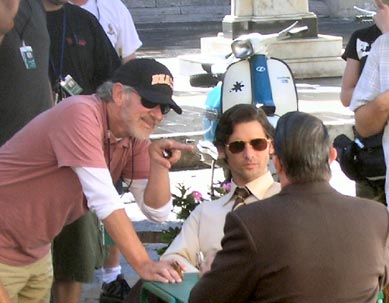
Speilberg hits back


Here:

In an interview with the German news weekly Der Spiegel, Spielberg says Munich aims to reclaim the debate about the moral costs of the struggle against terror from "extremists".

"Should you leave the debate to the great over-simplifiers? The extreme Jews and extreme Palestinians who consider any kind of negotiated settlement to be a kind of treason?" he said.

"I wanted to use the medium of film to make the audience have a very intimate confrontation with a subject that they generally only know about in an abstract way, or only see in a one-sided way."

Munich, which hit US screens last month, depicts an Israeli campaign to hunt down and kill Palestinian radicals behind the hostage-taking of Israeli athletes and coaches during the Munich Olympics in 1972.

The drama ended in a massacre: 11 Israelis, five Palestinians and one German police officer were killed.

Munich has been attacked by some US Jewish commentators who have accused Spielberg of equating the Israeli assassins with the Palestinian militants.

Spielberg dismissed the charges as "nonsense".

"These critics are acting as if we were all missing a moral compass. Of course it is a horrible, abominable crime when people are taken hostage and killed like in Munich," he said.

"But it does not excuse the act when you ask what the motives of the perpetrators were and show that they were also individuals with families and a history.... Understanding does not mean forgiving. Understanding does not mean being soft, it is a courageous and strong stance."

IAF missile strike kills one in Gaza City

Haaretz:

Israel Air Force aircraft fired missiles at a car in the Gaza Strip on Sunday afternoon in an apparent targeted killing of Palestinian militants.

The missile strike caused an explosion that rocked the Zeitoun neighborhood of Gaza City.

Mahmoud Abad Al A'al, a member of the Palestinian Popular Resistance Committees umbrella group, was killed and six others were wounded in the air strike.

Earlier, the Palestinian Popular Resistance Committees group admited its members had been traveling in the car but denied they had been hurt, claiming they managed to escape before the blast. A spokesman for the group said a bystander was killed.

IAF warplanes and drones were seen in the sky during the strike.

Tawfiq Abu Khoussa, spokesman for the Palestinian Interior Ministry, said an investigation into the incident was under way.

Earlier on Sunday afternoon, Palestinian militants opened fire on Israel Defense Forces soldiers patrolling Israel's border with the northern Gaza Strip. There were no casualties in that incident.

Tehran plans nuclear weapon test by March

UPI:

Tehran is planning a nuclear weapons test before the Iranian New Year on March 20, 2006 says a group opposed to the regime in Tehran.

The Foundation for Democracy citing sources in the U.S and Iran offered no further information.
The FDI quotes sources in Iran that the high command of the Revolutionary Guards Air Force have issued new orders to Shahab-3 missile units, ordering them to move mobile missile launchers every 24 hours in view of a potential pre-emptive strike by the U.S. or Israel. The order was issued Tuesday, Jan. 16.

The group says the launchers move only at night, and have been instructed to change their positions "in a radius of 30 to 35 kilometers." Prior to the new orders the Shahab-3 units changed position on a weekly basis. Advance Shahab-3 units have been positioned in Kermanshah and Hamadan province, within striking distance of Israel. Reserve mobile launchers have been moved to Esfahan and Fars province.

Saturday, January 21, 2006

Some big talk from the bug cave

Washington Times:

This editorial is the opinion of it's author only and in no way reflects the views of this blog(ger).

By Wesley Pruden

That may be Osama bin Laden crying "uncle." Or it might be Osama crying out to make mischief. He might not make peace in the saloons, but he could make trouble in the salons.

The villain of September 11 threatens to attack Fortress America again, blowing hard about how he can huff, puff, sweat, strain and maybe even burp any time he wants to. The most interesting and perhaps revealing part of the audiotape, broadcast yesterday on Al Jazeera, was his convoluted feeler for "a long-term truce" with the Great Satan.

The White House replied with the hard-nosed reply everyone, perhaps even Osama himself, should have expected: "Clearly the al Qaeda leaders and other terrorists are on the run," the president's spokesman said. "They're under a lot of pressure. We do not negotiate with terrorists. We put them out of business."

Even the top Democrat speaking ex-officio reacted semi-responsibly, briefly echoing the White House. "You don't negotiate with terrorists," Howard Dean, the chairman of the Democratic National Committee, told Fox News Channel. "These people have killed 3,000 Americans. There is no truce with al Qaeda, and there never will be. You can't trust them. I think we're doing exactly the right thing on the Pakistani border."

But Howard Dean being Howard Dean, the leader of the death-wish cult couldn't restrain his impulse to blow off a little partisan steam: "I do again point out, I wish we had not spent as much of our time and efforts in Iraq as we have, because the real battle against terror is in Afghanistan and the surrounding areas where al Qaeda is now holed up."

The vice president offered the view most popular in Washington. "I'm not sure what he's offering by way of a truce," Dick Cheney told interviewers. "I don't think anyone would believe him. It sounds to me like it's some kind of ploy."

Osama, though an archvillain who deserves whatever misery God, Allah and the U.S. Armed Forces deal to him, is not dumb, and he has demonstrated that he understands a little about how politics and public opinion work in the land of the big PX. The voice on the tape, which the CIA quickly identified as authentic, refers to dates and places calculated to reassure his followers that he may have diseased kidneys and maybe even a leaky bladder, but he's staying alive with the bugs and snakes in the bat cave somewhere on the Pakistan-Afghanistan border.

His blustery threats to inflict more mayhem on Jewish and Christian innocents seem aimed at encouraging his partners in crime, boasting that just because he hasn't inflicted evil since September 11 doesn't mean he can't do it when he wants to. "The proof of that," he says, "is the explosions you have seen in the capitals of European nations. The delay in similar operations happening in America has not been because of failure to break through your security measures. The operations are under preparation, and you will see them in your homes the minute they are through with preparations, with God's permission."

Wise men (so called) in the intelligence services warn against blowing off stuff like this as mere bloviation, however tempting that may be. Osama's boasts of coming carnage in America sound a lot like the defiance of the outlaw cornered by the patient Marshal Rooster Cogburn in "True Grit." When Rooster threatens to take Lucky Ned Pepper back to Fort Smith "to be hanged at Judge Parker's convenience," the old outlaw returns empty contempt and daring: "That's mighty big talk, Rooster, from a one-eyed fat man." We all know what happened to the not-so-lucky Mr. Pepper.

The latest from Osama may be aimed most of all at the anti-war left in America, the Democrats desperate to destroy the presidency of George W. Bush oblivious of the collateral damage inflicted on everyone else. Osama explains that he is directing his offer of a truce -- a "peace process," you might say -- because public-opinion polls show "an overwhelming majority of you want the withdrawal of American troops from Iraq but [Bush] opposes that desire."

But if Osama is as smart as a lot of people in the West think he is, he knows that a truce is the last thing the radical left, including a lot of Democrats in Congress, want. Such a truce, which would differ not at all from al Qaeda surrender, would redeem George W. overnight. His approval numbers would soar, and the blue states would turn to a deep shade of crimson.

Such a surrender would save the American lives the president's critics insist are their only concern, but at what cost? The prospects of restoring Democratic control of Congress would evaporate. So no truce, please. No peace. Not yet.

Wesley Pruden is editor in chief of The Times.

Israeli Hints at Preparation to Stop Iran

AP:

Israel's defense minister hinted Saturday that the Jewish state is preparing for military action to stop Iran's nuclear program, but said international diplomacy must be the first course of action.

"Israel will not be able to accept an Iranian nuclear capability and it must have the capability to defend itself, with all that that implies, and this we are preparing," Shaul Mofaz said.

His comments at an academic conference stopped short of overtly threatening a military strike but were likely to add to growing tensions with Iran.

Germany's defense minister said in an interview published Saturday that he is hopeful of a diplomatic solution to the impasse over Iran's nuclear program, but argued that "all options" should remain open.

Asked by the Bild am Sonntag weekly whether the threat of a military solution should remain in place, Franz Josef Jung was quoted as responding: "Yes, we need all options."

French President Jacques Chirac said Thursday that France could respond with nuclear weapons against any state-sponsored terrorist attack.

Iranian Foreign Ministry spokesman Hamid Reza Asefi said Saturday that Chirac's threats reflect the true intentions of nuclear nations, the official Islamic Republic News Agency reported.
"The French president uncovered the covert intentions of nuclear powers in using this lever (nuclear weapons) to determine political games," IRNA quoted Asefi as saying.

Israel long has identified Iran as its biggest threat and accuses Tehran of pursuing nuclear weapons. Iran says its atomic program is peaceful.

Iran broke U.N. seals at a uranium enrichment plant Jan. 10 and said it was resuming nuclear research after a 2 1/2-year freeze. Germany, France and Britain said two days later that talks aimed at halting Iran's nuclear progress were at a dead end and called for Iran's referral to the U.N. Security Council.

The International Atomic Energy Agency, the U.N. nuclear watchdog, will meet Feb. 2 to discuss possible referral.

Israel's Mofaz said sanctions and international oversight of Iran's nuclear program stood as the "correct policy at this time."

In Germany, Jung called himself "confident that there will be a diplomatic solution in the case of Iran."

Israeli leaders have also repeatedly said they hope the crisis can be resolved through diplomacy, and they said any military action would have to be part of an international effort. They have denied having plans for a unilateral preventive strike.

Russian President Vladimir Putin has said Tehran might still agree to Moscow's offer to move its uranium enrichment program to Russia, a step backed by the United States and Europeans as a way to resolve the deadlock.

Israel's concerns about Iran have grown since the election of Iranian President Mahmoud Ahmadinejad, who said last year that Israel should be "wiped off the map."

On Friday, Iran's Students News Agency reported Friday that Central Bank governor Ebrahim Sheibani said Iran had begun moving its foreign currency reserves from European banks and transferring them to an undisclosed location as protection against possible U.N. sanctions.

Sheibani backed away Saturday from his statement that the transfers were already underway, and Iran's Central Bank said there had been no change in its currency policy.

Estimates put Iranian funds in Europe at as much as $50 billion.

Syria accuses Israel of assassinating Arafat

Reuters:

Syrian President Bashar al-Assad accused Israel on Saturday of assassinating former Palestinian leader Yasser Arafat, the cause of whose death 14 months ago remains a mystery.

"Of the many assassinations that Israel carried out in a methodical and organized way, the most dangerous thing that Israel did was the assassination of President Yasser Arafat," Assad told a gathering of Arab lawyers.

"This was under the world's gaze and its silence, and not one state dared to issue a statement or stance toward this, as though nothing happened."

Arafat died in Paris on November 11, 2004 at the age of 75 after being rushed from his West Bank compound to a French military hospital.

Israel has denied being responsible for the deterioration in Arafat's health before his death and has denied poisoning him.

Israeli officials said he had access to medical treatment, food, water and medication during the two years he spent in his battered compound in Ramallah, which was besieged by Israeli troops for months in 2002.

French doctors denied rumors that Arafat was poisoned but have refused to publish his medical reports, citing strict privacy laws.

Arafat aides had quoted doctors as saying he had a low count of platelets, which help the blood to clot. They later said he had gone into a coma, suffered a brain hemorrhage and lost the use of his vital organs one by one. But no definitive cause of death was announced.

Palestinian killed in Gaza Strip

Reuters:

The Israeli army shot dead a Palestinian man and wounded two others in the north Gaza Strip close to the border with Israel on Saturday, local medics said.

The Israeli army confirmed the incident and said that troops had spotted three men crawling towards the border fence and had shot at them after they refused calls to stop, did not identify themselves and ignored warning shots fired in the air.

An army spokeswoman could not confirm whether the three men were armed or if their actions were hostile.

Palestinian medics said the three men had come from a refugee camp in the central Gaza Strip but did not know whether they were militants.

Israel has declared areas close to the border fence in the northern part of the costal territory which militants have used to fire rockets into Israel as a no-go area for Palestinians and has used artillery and helicopter gunships to enforce this.

Palestinians have condemned the buffer zone as a re-occupation of land evacuated by Israel last year.

Friday, January 20, 2006

Krauthammer - The Iran Charade, Part II

Washington Post:

"It was what made this E.U. Three approach so successful. They [Britain, France and Germany] stood together and they had one uniform position."

-- German Chancellor Angela Merkel, Jan. 13


Makes you want to weep. One day earlier, Britain, France and Germany admitted that their two years of talks to stop Iran's nuclear weapons program had collapsed. The Iranians had broken the seals on their nuclear facilities and were resuming activity in defiance of their pledges to the "E.U. Three." This negotiating exercise, designed as an alternative to the U.S. approach of imposing sanctions on Iran for its violations of the Non-Proliferation Treaty, had proved entirely futile. If anything, the two-year hiatus gave Iran time to harden its nuclear facilities against bombardment, acquire new antiaircraft capacities and clandestinely advance its program.

With all this, the chancellor of Germany declared the exercise a success because the allies stuck together! The last such success was Dunkirk. Lots of solidarity there, too.

Most dismaying was that this assessment came from a genuinely good friend, the new German chancellor, who, unlike her predecessor, Gerhard Schroeder (now a wholly owned Putin flunky working for Russia's state-run oil monopoly), actually wants to do something about terrorism and nuclear proliferation.

Ah, success. Instead of being years away from the point of no return for an Iranian bomb, as we were before we allowed Europe to divert anti-proliferation efforts into transparently useless talks, Iran is probably just months away. And now, of course, Iran is run by an even more radical government, led by a president who fervently believes in the imminence of the apocalypse.

Ah, success. Having delayed two years, we now have to deal with a set of fanatical Islamists who we know will not be deterred from pursuing nuclear weapons by any sanctions. Even if we could get real sanctions. Which we will not. The remaining months before Iran goes nuclear are about to be frittered away in pursuit of this newest placebo.

First, because Russia and China will threaten to veto any serious sanctions. The Chinese in particular have secured in Iran a source of oil and gas outside the American sphere to feed their growing economy and are quite happy geopolitically to support a rogue power that -- like North Korea -- threatens, distracts and diminishes the power of China's chief global rival, the United States.

Second, because the Europeans have no appetite for real sanctions either. A travel ban on Iranian leaders would be a joke; they don't travel anyway. A cutoff of investment and high-tech trade from Europe would be a minor irritant to a country of 70 million people with the second-largest oil reserves in the world and with oil at $60 a barrel. North Korea tolerated 2 million dead from starvation to get its nuclear weapons. Iran will tolerate a shortage of flat-screen TVs.
The only sanctions that might conceivably have any effect would be a boycott of Iranian oil. No one is even talking about that, because no one can bear the thought of the oil shock that would follow, taking 4.2 million barrels a day off the market, from a total output of about 84 million barrels.

The threat works in reverse. It is the Iranians who have the world over a barrel. On Jan. 15, Iran's economy minister warned that Iran would retaliate for any sanctions by cutting its exports to "raise oil prices beyond levels the West expects." A full cutoff could bring $100 oil and plunge the world into economic crisis.

Which is one of the reasons the Europeans are so mortified by the very thought of a military strike against Iran's nuclear facilities. The problem is not just that they are spread out and hardened, making them difficult to find and to damage sufficiently to seriously set back Iran's program.

The problem that mortifies the Europeans is what Iran might do after such an attack -- not just cut off its oil exports but shut down the Strait of Hormuz by firing missiles at tankers or scuttling its vessels to make the strait impassable. It would require an international armada led by the United States to break such a blockade.

Such consequences -- serious economic disruption and possible naval action -- are something a cocooned, aging, post-historic Europe cannot even contemplate. Which is why the Europeans have had their heads in the sand for two years. And why they will spend the little time remaining -- before a group of apocalyptic madmen go nuclear -- putting their heads back in the sand. And congratulating themselves on allied solidarity as they do so in unison.

Mofaz: Iran, Syria behind Tel Aviv attack

Ynet:

Defense officials have gathered solid evidence in the hours following Thursday's suicide bombing in Tel Aviv to show the attack was a direct result of cooperation between Iran, Syria, and Palestinian terrorists.

"The attack was funded by Iran, planned by Syria, and executed by the Palestinians," Defense Minister Shaul Mofaz charged during a meeting with top security officials in Tel Aviv following the bombing.

Security officials are intimately familiar with the phenomenon of terror attacks that originate outside Israel's borders. Various findings uncovered in the wake of past bombings showed that although the terrorists and explosive devices were local, a large overseas infrastructure financed attacks and pushed for their execution.

During Thursday's meeting, Mofaz said "we possess conclusive evidence that the attack is a direct result of the terror axis operating against Israel at all times." Defense officials were able to trace, based on "unequivocal evidence," the funding of the attack to Iran. Meanwhile, the Islamic Jihad headquarters in Damascus was the one to provide operative orders that resulted in the bombing, according to the evidence.

The execution of the attack was entrusted with an Islamic Jihad cell in the West Bank town of Nablus, where the suicide bomber originated.

Despite the charges of Iranian and Syrian complicity in the attack, defense officials do not intend to change the pattern of counter-terror operations at this time, particularly in light of the current sensitive junction and the upcoming Palestinian elections.

During Thursday's consultation, Minister Mofaz ordered the IDF and Shin Bet to continue operating against Islamic Jihad targets in the northern West Bank, tighten the siege around Nablus, and boost operations in areas where the security fence has not yet been completed.

Mofaz's declarations regarding Iranian and Syrian involvement in the attack come against the backdrop of a meeting between the two countries' leaders tonight. The defense minister characterized the Ahmadinejad-Assad summit as a "terror summit" and said the Iranian president is currently in the only place in the world where he's welcomed.

Security officials said remarks by the two leaders in Damascus overnight attest to their support of terrorism against Israel. Among other statements, Ahmadinejad and Assad said "the continued Palestinian resistance is the only way to regain the Palestinian nation's legitimate rights over the occupied Islamic territories."

Mofaz noted the Iranian-Syrian "terror axis" is not only Israel's problem and said he turned to American, European, and Egyptian officials in order to present to them the incriminating evidence, which he said leaves no room for doubt.

Thursday, January 19, 2006

Jewish tennis player taunted with 'Osama' jibes

From here:

American journeyman tennis pro Paul Goldstein has played tennis all over the world. He is no stranger to rowdy or hostile crowds.

But during his first round match against Serbian Novak Djokovic at the Australian Open on Tuesday, he experienced something new. During his ball toss, a group of pro-Djokovic fans screamed "Osama". Soon thereafter, a fight broke out in the stands.

Goldstein, who is Jewish, said: "While I'm serving, I'm hearing a little Osama bin Laden stuff. I didn't say one word to them. American friends were standing right next to them and at one point [said], 'Why don't you shut up?' So they got into it."

The Goldstein incident underlines one of the more unsavoury aspects of tennis' first grand slam tournament - the increasingly boorish behaviour of its fans.

In an another match, the second-round clash between Marcos Baghdatis of Cyprus and the Czech Radek Stepanek, the cheering for the Cypriot went beyond good-natured.

In scenes more often associated with the football terraces, a mob of fans routinely interrupted Stepanek when he was serving, beating incessantly on the courtside hoardings.

Tennis, like golf, carries an unwritten, but generally well-observed etiquette for both players and fans. It is one of the few sports, for example, in which tradition dictates silence during play.
But the further one gets from the traditional centre of the game - Europe - the more these traditions seem to have eroded.

While the All-England Club and Roland Garros are considered tame and proper, Flushing Meadows (site of the US Open) and Melbourne Park are becoming increasingly raucous. And the Davis Cup - played in countries across the globe - is the most boisterous of them all.

Most followers of the game have welcomed this development. Fans at the Australian and US Opens have brought much needed youth and passion to the sport.

But there's a breaking point. And if the Goldstein and Baghdatis incidents are anything to go by, the Australian Open had better watch its faults.

Matisyahu on Letterman video

Under-fire Iran, Syria leaders close ranks

AFP:

Under-fire allies Damascus and Tehran, faced with growing isolation, closed ranks in talks between Syrian President Bashar al-Assad and his Iranian counterpart Mahmoud Ahmadinejad.

"Iran has the right to build up nuclear technology for peaceful purposes," Assad said at a joint press conference after their meeting.

"We expressed our support for Iran in its pursuit of peaceful nuclear technology and we back the idea of a dialogue with international parties," said the Syrian leader. "We also reject the pressure being exerted on this country" over its nuclear program.

Ahmadinejad's trip to Damascus comes ahead of an emergency meeting of the International Atomic Energy Agency's 35-nation board on February 2, called by European nuclear negotiators aiming to refer Iran to the UN Security Council.

Iran said this month it was halting a voluntary moratorium on sensitive uranium enrichment research -- a step short of a process that could be extended to make the core of a nuclear weapon.

The move has prompted alarm around the world and driven oil prices higher.

The Islamic republic insists it only wants to make reactor fuel to generate electricity, and asserts it has the right to do so under the nuclear Non-Proliferation Treaty.

On Lebanon, Assad said Syria and Iran wanted stability there but stressed "the need to support the resistance" to Israel, in reference to the radical Lebanese Shiite movement Hezbollah.

Syria, the former power-broker in Lebanon, was opposed to "any interference in the internal affairs of Lebanon and its internationalization," he said.

He said Iran and Syria were also united in their support for the resistance against Israel and the establishment of an independent Palestinian state.

Hardliner Ahmadinejad was at the start of a two-day visit to Syria, Tehran's only regional ally, as both countries struggle to fend off mounting international pressure.

Iran faces possible UN sanctions over Iran's disputed nuclear program, while Assad's regime is also increasingly isolated over its alleged involvement in former Lebanese premier Rafiq Hariri's murder in February 2005.

On Wednesday, Ahmadinejad said "our position on regional issues is clear. We reject any foreign interference," a reference to the pressure on Damascus over the assassination.

An Iranian presidential official said economic issues would figure high on the agenda of the visit.
Iran and Syria are both under US sanctions for their alleged sponsorship of terrorism and quest for weapons of mass destruction. They also stand accused of playing a spoiling role in their shared neighbour Iraq.

Damascus's ties with neighbouring Lebanon have been increasingly strained since the Hariri assassination, which stirred an international outcry and led to Syria's military pullout from Lebanon last April after a 29-year deployment.

The UN probe into the murder has implicated top-level Syrian and Lebanese intelligence officials, and it has asked to interview Assad..

Syria has denied involvement and described the UN probe as biased, a position Iran's state-run press and government officials have consistently supported.

Tehran and Damascus also back Hezbollah, which is called on to disarm under UN Security Council Resolution 1559, adopted in September 2004.

Apart from the nuclear dispute, Ahmadinejad has also made a series of anti-Israeli outbursts in recent months, describing the Jewish state as a "tumor" and calling for Israel to be "wiped off the map."

The alliance between Tehran and Damascus dates back to the Iran-Iraq war of 1980-1988 when Syria sided with the Islamic republic against Iraqi dictator Saddam Hussein.

A number of economic accords are expected to be signed during Ahmadinejad's visit.

Yearly trade between the two totals some 100 million dollars, according to the Iranian embassy. Iran has invested 750 million dollars in Syria, including the construction of two cement factories and several silos.

IAF jets scrambled to escort El Al plane wrongly thought to have been hijacked

Haaretz:

Two Israel Air Force war planes were scrambled on Thursday afternoon to escort an El Al Israel Airlines passenger plane that was thought to have been hijacked.

Air traffic controllers lost contact with the civilian plane, which was traveling from Moscow to Tel Aviv, for three minutes but the report on the hijacking was subsequently proven to be incorrect.

The airliner landed safely in Israel. El Al expressed amazement that IAF jets were scrambled so quickly.

The plane, a 757 Boeing carrying 79 travelers, lost contact with European air-traffic controllers while in flight. According to regulations, an airplane hijacking attempt was reported and Ben Gurion Airport was temporarily closed to all flight traffic. IAF F-warplanes planes were sent to escort the airlines.

El Al reported that an initial probe conducted by Deputy Director General of Operations, Lior Yavor, indicated the pilots failed to respond to Israeli air-traffic control for three minutes because they were in contact with Cyprus air-traffic control.

The plane landed without IAF escort and was immediately examined by security personnel.

Suicide bomber wounds 16 near old central bus station in Tel Aviv

Haaretz:

A suicide bomber blew up near the old central bus station in southern Tel Aviv at around 3:45 P.M. on Thursday, wounding at least 16 people.

Islamic Jihad said that it carried out the attack. The terrorist group has claimed responsibility for each of the six suicide bombings in Israel since a truce took effect last February.

Police said that the suicide bomber was the only person killed in the explosion.

The blast occurred at a shawarma stand close to the bus station, at the junction of Neveh Sha'anan and Salomon streets, in an area normally crowded with shoppers and travelers.

Witnesses said the bomber entered the restaurant pretending to be a peddler selling disposable razors. According to police, the bomber blew himself up in the restaurant's bathroom and may have been trying to prepare the explosive device when it went off prematurely.

Of the wounded, one person was in serious condition, four people sustained moderate wounds and nine others were lightly hurt, the television said.

All the wounded were evacuated from the site of the attack within a short time of the blast. They were taken to Wolfson Medical Center in Holon and Ichilov Hospital in Tel Aviv.

After the blast, a crowd gathered outside the restaurant. An elderly man wearing a felt hat wept."There was a huge boom near... a restaurant," witness Ronit Lis told Reuters. "Everything turned black and I ran away. They began to close the area down and there are a lot of ambulances in the area."

A witness, who identified himself only as Itzik, said he was eating at a fast-food stand when he began to suspect the man standing next to him."All of a sudden a policeman came, he pulled him out, and started searching him," he told Israel Radio. The suspect fled, Itzik said, and five minutes later the explosion was heard.

Israel said that the blame for the attack lay at the feet of the Palestinian Authority, which it said was doing nothing to fight terrorism. "The terror attack in Tel Aviv is a direct result of the Palestinian Authority's glaring indifference to preventing terror against Israel," David Baker, an official in the Prime Minister's Office, told Haaretz. "The PA continues its policy of refusing to take any steps whatsoever to prevent this terror, and ignoring its commitments to do so. It continues to sit idly by and do nothing."

Saeb Erekat, the chief Palestinian negotiator, condemned the attack, calling it an act of sabotage against Palestinian parliamentary balloting scheduled for next Wednesday.

"We condemn this attack," he said. "This is an attack to sabotage the Palestinian elections and sabotage the efforts being exerted to revive the peace process after the elections."

In the wake of the blast, the police raised the level of alert across the whole country, Channel 10 TV reported. Talking to reporters at the site of the attack, senior police officials said that it was too early to provide details of how the attack was carried out. A Palestinian suicide bomber last struck in Israel on December 5, killing five people outside a shopping mall in the coastal city of Netanya.

Wednesday, January 18, 2006

Hizbollah: Ron Arad probably dead

Reuters:

The leader of Lebanon's Hizbollah guerrilla group said on Wednesday he believed a missing Israeli airman at the heart of prisoner exchange negotiations with the Jewish state was probably dead and his remains lost.

"If any information were available to us about Ron Arad we would have made a new deal," Sayyed Hassan Nasrallah said in a televised interview on Lebanon's NTV channel.

"I have an analysis that is not based on tangible facts ... but if you asked me for my conclusion I would say that he is dead and lost... he died, no one knew of him and his remains have disappeared."

Nasrallah's comments mark the first time the group has directly said it does not have Arad's remains or hard information on his whereabouts. It had previously declined to comment on Arad's fate and said last year negotiations had reached a critical stage.

Israel and Shi'ite Muslim Hizbollah carried out a German-mediated prisoner-swap in January 2004 that freed hundreds of Arab prisoners for a kidnapped Israeli businessman and the bodies of three Israeli soldiers.

Hizbollah, which is backed by Iran and Syria, had snatched those soldiers from a disputed border area in 2000 to pressure Israel into releasing Lebanese detainees held in its jails.

A second stage of talks is believed to have focused on Arad, who was downed during a bombing raid over Lebanon in 1986, and on four Iranian diplomats who disappeared in Lebanon in 1982, the year the Jewish state invaded Beirut.

Hizbollah wants the release of Samir al-Qantar, the longest-held Lebanese, who is serving a 542-year prison sentence for killing four Israelis in 1979.

Iran roundup

Reuters:

European Union powers on Wednesday began circulating a draft resolution calling on the U.N. nuclear watchdog (IAEA) to report Iran's nuclear programme to the Security Council, which is empowered to impose U.N. sanctions.

Following is a summary of positions in the diplomatic poker match over the Islamic republic's atomic ambitions.

DIPLOMATIC GROUNDWORK

Britain, France and Germany, the resolution sponsors with U.S. backing, are striving to win over wary Russia, China and developing states before submitting the motion to the IAEA's 35-nation governing board for an emergency meeting in February.

Russian and Chinese backing is indispensable to any chance of robust action by the Security Council, where both wield vetoes as permanent members. Without the support of weighty developing states such as Brazil and South Africa, the EU3-U.S. move could be vulnerable to Iran's stance that the West is bullying it and depriving smaller nations of energy sovereignty.

WHERE KEY PLAYERS STAND

Moscow and Beijing have hinted they will no longer block referral since Iran resumed nuclear fuel research of potential use to make atomic bombs. But both are wary of punishing Iran, in part because of close trade ties with the Islamic republic.

Developing states have long opposed a crackdown on Iran for fear of a precedent curbing their access to nuclear technology.

Western diplomats hope big powers and developing states will come around to referral because of Tehran's increasingly hardline stance and a flurry of calls for Israel's destruction.

EMERGENCY BOARD MEETING

The IAEA board will convene on Feb. 2 at the request of the EU3, a month ahead of schedule, to decide on the resolution. Western diplomats are sure of a simple majority, but want at least a two-thirds margin to widen a Security Council mandate for possible action. Non-Western states including Russia, China, Japan and South Korea comprise 22 of the 35 board members.

WHAT HAPPENS IF IRAN LANDS IN SECURITY COUNCIL

The council would first try warnings to Iran to renounce uranium enrichment work in exchange for trade incentives and security guarantees. If Iran refused, the council could consider trade sanctions. But these would be difficult to realise as many countries aside from the United States rely on oil imports from OPEC giant Iran, the world's fourth largest petroleum producer.

IRAN'S DETERRENT

Iran has said its nuclear research aims only to generate electricity for an energy-needy economy. But while calling for a return to talks with the EU, Tehran has hinted it could play "the oil card" to weaken its critics' resolve. Emboldened by high prices and a global supply squeeze, Iran could pull part of its daily crude sales of 2.4 million barrels from world markets.

IF ALL ELSE FAILS, MILITARY ACTION?

The United States and Israel have mooted the possibility of military action against Iran if diplomacy fails. But most diplomats see little chance of attacks since Iran's nuclear plants are widely dispersed and well-defended.

Militant-fired missiles bracket Israel

Jane's:

Most forms of attack against Israel have been reduced in recent months because of the ceasefire, but Qassam attacks have increased - 377 in 2005 compared to 309 the previous year. Israel believes that the persistent Qassam launches are testimony to the failure of its deterrence policy and that by withdrawing its forces from Gaza, Israel's ability to locate Qassam workshops and other engineering sites has been seriously impaired.

The Israelis have also come under rocket fire from Lebanon in recent weeks - in large part stemming from the political turmoil in Lebanon blamed on Syrian assassinations and destabilisation. Israel fears that the turmoil triggered in Lebanon by the assassination of former Prime Minister Rafiq Hariri on 14 February 2005, widely blamed on Syria, is deepening and that Syria will seek to further destabilise the situation in South Lebanon. Israeli intelligence chiefs have stated that Hizbullah, Syria's main ally in Lebanon, has been ordered to prepare missile bombardment of strategic facilities in northern Israel.

The Israelis claimed that Hizbullah has stockpiled 15,000 missiles and rockets provided by Iran and Syria, some with ranges of up to 100 km. A recent study by Rafael, Israel's armaments development authority, assessed that Hizbullah missiles had the range and power to destroy the oil refinery and chemical plants in the Haifa area, considered strategic targets by the Israelis.

Among the most powerful weapons supposedly in the Hizbullah arsenal are Iranian-made Fajr-3 and Fajr-4 systems with ranges of up to 70 km. There are also supposed to be enhanced 330 mm Katyushas. Hizbullah's leadership has never officially acknowledged having such a massive inventory, but has hinted that its forces are well supplied with missiles. Hizbullah, and through it Iran, has close links to Islamic Jihad in Gaza

South African radio station sorry for use of hate speech

Here:

Cape Town Muslim radio station, Voice of the Cape, has apologised for "a number of deeply offensive and hurtful attacks on Jews and the Jewish religion" during a broadcast.

The offending comments were made by Egyptian student Sheikh Muhamed Colby in a September 2004 programme titled Human Rights And Religion, in which he suggested that Jews were intent on world domination, and were ready to spill Muslim blood.

After a complaint by the Jewish Board of Deputies, which was represented by Advocate Anton Katz and attorney Mervyn Smith, the Broadcasting Monitoring and Complaints Committee ruled that Voice of the Cape should apologise for the comments, which were found to have amounted to hate speech.

The ruling, made in September but only ratified by the committee on Monday, required Voice of the Cape to broadcast a scripted and unreserved apology once on its main news bulletin and at the beginning and end of the programme which contained the original offensive comments.

The station was also ordered to adopt a set of measures to prevent the broadcast of any further offensive material.

In its apology, Voice of the Cape said Colby's statements did not represent the station's views."In no way do we hold the Jewish community in contempt. Islam teaches us to respect all religions. We apologise unreservedly and unequivocally for any offence or harm caused to the Jewish community as a result of the broadcast."

Colby's speech suggested that white Europeans, Zionists and Americans were responsible for a number of human rights violations, including the nuclear bombings of Hiroshima and Nagasaki in 1945." As far as Judaism is concerned, they believe that they are the chosen nation by God Almighty," he said. "They believe they have been created to enslave and subjugate humanity and take full control of all matters of life.

"When they look at any other religion or sect, other than Judaism, they look at that sect as a means of enslavement, killing, slaughtering, murdering; any form, any means, as long as they reach their aim and their goal." Colby said the "protocol of the wise Zionist" involved asking what steps could be taken to take "total control of the world".

"This is how they control the nation. This is how they control everything." Colby said the blood of Muslim people was halaal (permissible) for Jews."We are seeing... that the blood of the Muslim is running through the streets and nobody is doing anything about it... " he said.

Germany's Merkel opposes banning Iran from World Cup

Reuters:

Chancellor Angela Merkel will not seek to ban Iran from the World Cup Germany is hosting because of inflammatory statements from Iran's president about Israel and the Holocaust, a government spokesman said on Wednesday.

Ulrich Wilhelm said Merkel does not believe Iran's soccer team or the country's fans should be punished over the remarks about Israel and the Holocaust by Iranian President Mahmoud Ahmadinejad, which she has condemned as unacceptable.

"Chancellor Merkel has made clear she personally doesn't believe in measures such as banning Iran from the World Cup that Germany is hosting," Wilhelm said when asked about a letter from an Israeli member of parliament urging her to exclude Iran.

"That would punish the sportsmen and the sport enthusiasts, the people, for the actions of a government," Wilhelm added. "But she believes his deplorable remarks are unacceptable and must be challenged politically in every way possible."

Gilad Erdan, a member of the Likud party who is chairman of the Israeli parliament's sports subcommittee, wrote to Merkel urging her to ban Iran from the world's top soccer tournament unless it retracts its views on Israel and the Holocaust.

"Dr. Merkel, you have a rare opportunity to take action and to signal to Iran that this latest behaviour is unaccepted by the international community and unaccepted by Germany and on German soil," he wrote in the letter obtained by Reuters.

Ahmadinejad has called in recent months for Israel to be "wiped off the map" and has referred to the Holocaust as a myth.

Erdan said he wrote the letter in response to Iran's announcement on Sunday that it was planning to hold a conference to assess the scale of the Holocaust.

Six million Jews died at the hands of Germany's Nazi regime between 1933 and 1945. Holocaust denial is a crime in Germany, punishable with a prison term of up to five years.

Merkel has condemned Ahmadinejad's comments but said earlier this month that she opposed banning Iran from the 32-nation tournament, which is due to take place in Germany from June 9 to July 9.

Some German soccer leaders have also spoken out in favour of banning Iran for the comments, in particular for denying the Holocaust.

Appliance makers add 'Sabbath mode' to new products

From here:

While manufacturers were thinking up ways to make kitchen appliances better, Orthodox Jews were yearning for the good old days of simple gas ovens.

First came the 12-hour automatic safety shutoff. Then electronic controls and digital displays followed, further complicating the lives of Jews who observe Sabbath rules that forbid starting or turning off fire or its modern-day equivalent: electricity.

What happened was technology created all these problems for us, and now we're using technology to shut them off," said Jonah Ottensoser, a mechanical engineer who certifies appliances as kosher-consumer-friendly for Star K, a nonprofit kosher certifying agency based in Baltimore.

Ottensoser, who lives in Baltimore and maintains a kosher kitchen at home, works with manufacturers on their ovens and refrigerators -- the two appliances that cause the most problems for observant Jews -- to create "Sabbath modes," or ways for consumers to override automatic features.

Observant Jews would often turn on their ovens before sundown on Friday and leave them on until sundown on Saturday in order to have hot food on the Sabbath, when no work is allowed. The mechanical knobs didn't cause any electrical currents and simply raised or lowered the temperature.

But then manufacturers began including automatic 12-hour shutoffs for safety reasons, causing problems for Jews on Sabbaths and holidays.

"A lot of people leave a porridge-type concoction in for lunch on the next day," Ottensoser said. "With holidays, sometimes it can be two or three consecutive days."

With Ottensoser's help, several manufacturers have programmed "Sabbath mode" features into their ovens. Any consumer who wants to can enable it to override the automatic shutoff and turn off the electronic display icons. The oven's temperature can be changed while in the Sabbath mode, but no displays show up on the screen to indicate those changes. Many users leave a thermometer inside the oven to keep track of the temperature.
"It's a little like flying blind," Ottensoser said.

Star-K first worked with the KitchenAid division of Whirlpool about 10 years ago to develop a Sabbath mode. Manufacturers were interested in making their products useful for Jewish consumers, and Star-K had developed a reputation of successfully applying Jewish law to modern life, according to Star-K President Avrom Pollack. Today, about a dozen manufacturers have worked with the company to install Sabbath mode features on their appliances. The features come standard on most new ovens and do not raise the appliance's price. Sometimes the manufacturers automatically include Sabbath mode features, while other times they're reminded by Jewish consumers.

"One of the manufacturers put an automatic shutoff on the warming drawer and forgot that people might want to keep it on," said Susan Yudin, chief operating officer of Yudin's appliance store in Wyckoff. "We're the ones who pointed it out to Star-K, who pointed it out to the manufacturer."

Yudin's store has developed a reputation in the region as a specialist in appliances for kosher kitchens. About a month ago, Dacor shipped its new oven with a Sabbath mode to the store, and Yudin's had Ottensoser test it. The store owners also worked with Star-K to develop new products for Jewish consumers.

"We worked with Mr. Ottensoser with General Electric to devise a Sabbath switch for one of their refrigerators, and we got the first one coming out of the GE factory," Yudin said.
Sabbath mode features for refrigerators turn off any digital displays and make sure that the light doesn't come on when the door is opened. In addition, they make sure that the condenser fan doesn't activate during the Sabbath; normally, the fan would come on after the refrigerator door is opened a certain number of times.

While some refrigerators have an internal Sabbath mode feature that simply needs to be activated, others require that a small box be installed inside the refrigerator that allows consumers to switch between regular and Sabbath modes.

For other refrigerators, users simply have to create their own Sabbath modes by either unscrewing light bulbs or taping down the switches that turn on the lights.

"Sometimes you have to live with certain handicaps for certain items," Ottensoser said. "People have gotten used to it. It's not an issue."

German intelligence aiding Israel on Iran

UPI:

The German media reports that the BND Federal Intelligence Service has been quietly assisting Israel's Mossad intelligence service on Iran.

According to the Kolner Stadt-Unzeiger, Germany's Bundesnachrichtendienst has been providing Mossad with documents permitting agents to travel the Middle East on "delicate employments" with German documentation, according to a former high-level BND agent.

The anonymous BND source further asserted that Mossad agents are using their German travel documents in Iran in connection with possible air raids on Iranian nuclear facilities, which have recently been reported as being scheduled for March.

Germany, with European Union partners Britain and France, has for months been attempting to negotiate a way out of the international impasse over Iran's self-proclaimed civilian nuclear energy program, which the Bush administration and Israel insist is a covert platform for a secret military program.

In the wake of the failure of Monday's talks with Tehran, Germany is calling for an urgent meeting of the United Nations International Atomic Energy Agency in February.

Tuesday, January 17, 2006

The Pakistan predicament

LA Times:

Pakistani officials claim last week's U.S. bombing of a western village killed not the intended target, No. 2 Al Qaeda leader Ayman Zawahiri, but at least 17 others, including women and children. If so, relatives of the dead deserve an apology and reparations; Washington also needs to express regret to President Pervez Musharraf's government.

The message can be delivered this week when Pakistan's prime minister visits the U.S. But at the same time, the prime minister should be reminded that if Islamabad actually tried to find Zawahiri and his boss, Osama bin Laden, instead of just pretending to do so, such attacks would not be repeated.

More than four years after Al Qaeda's 9/11 attacks, Pakistan continues to play a dangerous game. The government does as little as possible to hunt Al Qaeda operatives, lest their Pakistani supporters become even more upset with Musharraf. Yet Islamabad continually assures Washington that it's in vigorous pursuit, in order to keep the foreign aid flowing.

A quarter of a century ago, the U.S. funded and armed Islamic extremists in Pakistan to cross the border and fight the Soviet invaders of Afghanistan; when the Soviets left, the U.S. lost interest in the region. Pakistan supported the Taliban after it took over Afghanistan and gave sanctuary to Al Qaeda. After 9/11, Musharraf claimed to have reversed course and threw in his lot with the U.S.

Washington has rewarded Pakistan with a five-year, $3-billion aid package. Musharraf promised to close the madrasas — fundamentalist schools that foment anti-Americanism — but progress has been slow. And the problem doesn't just lie with the private madrasas. The nation's public schools use textbooks promoting violent battles against infidels. The province where Friday's apparently botched attempt to kill Zawahiri occurred now has a pro-Taliban government, making it harder for Islamabad to search for Al Qaeda. But difficulty is not impossibility.

Pakistan claims to have captured more than 700 suspected Al Qaeda operatives in recent years. One notable prisoner was Khalid Shaikh Mohammed, planner of the 9/11 attacks. But the hunt for terrorists clearly represents a low priority.

The commendable U.S. response to last year's earthquake in Pakistan's northern region, including U.S. troops, civilian aid agencies and funds, did much to improve the U.S. image in the country. If last week's bombing turns out to be based on faulty information, the deaths will further inflame anti-American feeling. More important, they would be a deeply regrettable loss of innocent life. It's true that in war "stuff happens," but that does not lessen the tragedy when women and children are killed accidentally.

Sharon starts to fade from the front page

Reuters:

Ariel Sharon left the political stage with a bang, but a sense of quiet acceptance has settled over
Israel as the 77-year-old leader lies comatose in a Jerusalem hospital.

Two weeks after he was felled by a massive stroke, updates on the prime minister's condition are taking second or third billing in Israeli media to reports on Jewish settler unrest in the
West Bank city of Hebron or regional cases of bird flu.

Almost no one in Israel expects the former general, a dominating force in the Middle East for decades, to return to office.

The political focus has shifted to Ehud Olmert, the career politician who replaced him, as Israel moves toward a March 28 general election.

"We can't just rest our hopes on one man, much as I admire him," Yaakov Sheetrit, a Jerusalem shopkeeper, said about Sharon. "I want someone to preserve what he built."

Sharon staked a claim to Israel's political center by withdrawing settlers and soldiers from the Gaza Strip last September and forming a new party, Kadima, after bolting the right-wing Likud.

Many Israelis saw Sharon as a strong leader who could make the bold decisions needed to end conflict with the Palestinians.

He leaves behind a party system in flux, after leadership changes in the Likud and center-left Labor, and a mostly untested generation of politicians trying to fill his shoes.

Olmert, a former two-term mayor of Jerusalem, has received high marks in Israeli opinion polls for a smooth transfer of power. The surveys show Kadima, with Olmert at its helm, on course to win the national ballot.

Olmert: Israel will not allow Iran to obtain WMD

AFP:

Israel's Acting Prime Minister Ehud Olmert warned Iran that the Jewish state would not allow any regime which threatened its existence to obtain weapons of mass destruction.

"Israel cannot allow in any way or at any stage someone who has such hostile intentions against us to obtain weapons that could threaten our existence," Olmert said amid growing international pressure to bring Tehran before the UN Security Council over its nuclear programme.

Israel has come to view the Islamic republic in Tehran as its number one enemy and its fears were heightened when Iranian President Mahmoud Ahmadinejad in October called for the Jewish state to be "wiped off the map."

Iran is facing the threat of being referred to the UN Security Council for resuming sensitive nuclear fuel research work that Israel and the Western powers fear would give the regime the know-how to build a bomb.

Tehran insists such work is legal given it has signed the nuclear Non-Proliferation Treaty and has branded atomic weapons "un-Islamic".

As a high-level Israeli delegation headed to Moscow for talks over Iran's nuclear programme, Olmert said that he believed a diplomatic solution was possible.

"I believe that there is a way to prevent non-conventional weapons coming into the hands of those who pose a danger to the entire world," Olmert said during a meeting with President Moshe Katsav on Tuesday.

"The Iranian issue is at the top of the agenda for the Israeli government as well as the international community.

"It is being dealt within a continuous manner with contacts between the government and those in Europe and the United States."

Israeli officials have played down the idea of a pre-emptive strike against Iran's nuclear facilities but the outgoing head of military intelligence, Aharon Zeevi, said last month that such a move was "not impossible".

In 1981, Israel bombed Iraq's French-built Osirak nuclear reactor.

Israel itself is believed to be the only nuclear power in the Middle East, although it has never admitted to having a non-conventional arsenal.

Suicide bomb film wins Golden Globe

BBC:

A Palestinian film that tackles the controversial subject of suicide bombs has won a top US cinema award, a Golden Globe for best foreign language film.

Paradise Now is about two friends from Nablus in the West Bank who volunteer to bomb Israeli civilians in Tel Aviv.

They get separated on the morning of their mission and have to make their own choices about what to do.

Director Hanny Abu-Assad said the prize was recognition "that the Palestinians deserve their liberty and equality".

In his acceptance speech, Mr Abu-Assad thanked distributor Warner Independent Pictures for its "faith and courage" in bringing the film in the US.

In an interview with the BBC News website last year, he said the film was a thriller that offered insight into the conditions and motives that create suicide bombers.

"The act of killing yourself at the same time as killing your enemy... is the most horrifying thing that anyone can do and it is made all the more horrifying because little is known about the people who carry out such extreme violence," he said.

The film is fictional but was researched using interviews with bombers' relatives, a lawyer who defended failed bombers and Israeli police reports. It was also incredibly difficult to make, Mr Abu-Assad said, under the conditions of the Palestinian uprising, or intifada, and Israel's occupation of the West Bank.

Mr Abu-Assad faced criticism about the subject matter from some people in Israel, although he received financial backing from the Israeli Film Fund.

Some Palestinian militant factions also objected to the ambiguities suggested in characters who they want to be portrayed as "superheroes", Mr Abu-Assad said.

Other nominees in the category were two Chinese films, Kung Fu Hustle and Master of the Crimson Armour, and Joyeux Noel from France and Tsotsi from South Africa.

Mr Abu-Assad's film has also been accepted as the Palestinian entry for the foreign language category for the Oscars in March.

Monday, January 16, 2006

CNN banned from Iran

CNN:

Iran's government banned CNN journalists from working in the country Monday after a translation error broadcast by CNN mistakenly quoted Iran's president as saying his nation has the right to build nuclear weapons, the state-run news agency said.

CNN was not informed directly by the Iranian government that it was banned from the country.
The dispute arises from a moment of simultaneous translation Saturday.

As Iranian President Mahmoud Ahmadinejad was speaking, an interpreter working for a translation company hired by CNN misquoted him as having said Iran has the right to build nuclear weapons.

In fact, he said Iran has the right to nuclear energy, and that "a nation that has civilization does not need nuclear weapons." He added, "Our nation does not need them."

The incorrect translation was aired on CNN later Saturday.

As soon as it was alerted to the error, CNN on Sunday corrected the translation and clarified Ahmadinejad's remarks. The network also apologized.

In a written statement, CNN said it "apologized on all its platforms which included the translation error, including CNN International, CNNUSA and CNN.com, and also expressed its regrets to the Iranian government and the Iranian ambassador to the U.N."

But the Iranian government, in the report by the state news agency IRNA, said it took a punitive measure against CNN, invalidating press cards of CNN journalists in Tehran.

The Foreign Press Department of the Ministry of Culture and the Islamic Guidance said it will not extend permits to CNN journalists because of the violation of "professional ethics," the IRNA report said.

The network, in its statement, said, "CNN is very disappointed that this action has been taken."
The translation company, Lesley Howard Languages, apologized to CNN.

"Obviously, we're taking it very, very seriously. We will never use him again," said owner Lesley Howard, referring to the interpreter.

She said the same interpreter, who like other interpreters is contracted for individual projects, has done good work in the past, including for CNN.

She added that there is no reason to believe the interpreter purposely gave the wrong translation.

"We pride ourselves on having incredibly high standards," Howard said.

BBC missed the point!

Recieved this in an email from a friend:

Whilst listening to the BBC World Service's report on the health of Ariel Sharon , this past Motzei Shabbos, I could not help myself from laughing aloud.

The BBC Correspondent reported how the journalists camped outside Haddassah Hospital had just watched a group of Ultra-Orthodox Jews come outside the hospital building, raise their heads up to the seventh floor, where Sharon was recuperating, and sing some prayers for his recovery.

I guess the BBC's Correspondent had never seen Kiddush Levanah before.

Baltimore Jewish Community lends a hand to Gaza families

Baltimore Sun:

Nearly five months have passed since Israel ordered its Jewish settlers out of Gaza, but Rabbi Elan Adler still is flying an orange sash from his van.

Adler, like many Orthodox Jews, opposed the unilateral pullout in August by the government of Prime Minister Ariel Sharon. But now, he says, his focus is on the fate of the families who were displaced. The spiritual leader of Moses Montefiore Anshe Emunah Hebrew Congregation plans to fly the color associated with the Gaza settlers until all have moved into new homes.

"For so many Jewish people locally, and around the country, once they left Gaza, I think it just fell off their radar screen, assuming that the government was doing everything it intended to get everybody resettled as quickly as possible," said Adler, president of the Baltimore Board of Rabbis. "But bureaucracy in Israel doesn't always make that happen so quickly."

Adler has invited the prominent former settler Anita Tucker to his shul tonight to speak about her experiences since the pullout.

The fundraiser is one of several efforts within the local Jewish community to support families affected by the pullout. The Associated: Jewish Community Federation of Baltimore has started a Disengagement Fund to support two agencies helping to resettle families.

Two all-female Jewish groups, Encore and Ayelet HaShachar, were to perform at a benefit concert yesterday at Yeshivat Rambam. Synagogues and individuals also are sending money overseas.

"There's a Hebrew phrase, 'Kol Yisrael areivim zeh lazeh,'" said Paula Guttman Scharfman, the lead singer of Encore. "It means we are responsible for our fellow Jews."

The pullout from Gaza and isolated settlements in the West Bank, which was supported by a majority of Israelis, was intended to reduce friction between the settlers and the Palestinians who outnumbered them in Gaza, and to allow Israel to solidify its hold on the West Bank. But some among the 9,000 who were displaced say the government has failed to compensate them for the homes and businesses they were forced to leave behind.

According to a new study by the Israeli nonprofit organization Lema'an Acheinu, 25 percent of former Gaza settlers still are living in hotels, The Jerusalem Post reported last week. More than 50 percent had yet to receive any compensation, according to the study.

A spokesman for the Israeli Embassy in Washington disputed those figures. Of the 1,700 families that have applied for compensation, spokesman David Siegel said, 700 have received all of what they are due, 300 have received at least 75 percent and 500 have received some payment. He said families now are receiving compensation within a month of completing the required paperwork.

Of the roughly 1,250 families that sought living arrangements through the Israeli Disengagement Authority, Siegel said, 1,000 have been moved into temporary homes while the construction of new homes is expedited. Fewer than 200 are still in hotels, he said.

"Most of the leadership of the settlers has embraced the Disengagement Authority and feels that they are doing everything they can to help, and that they are working the problems and trying to solve them," Siegel said. "The government is sincerely committed to doing everything to complete this process of resettling these families on a communal basis and as quickly as we can."

In Baltimore, much of the support for the former settlers is coming from the Orthodox community, where opposition to the pullout was strongest.

Tucker is on a U.S. speaking tour to talk about her experience and raise money for displaced families. The Brooklyn-born daughter of Jewish refugees, she and her husband helped to found the Gaza settlement of Netzer Hazani in 1976. There, in the cluster of settlements known as Gush Katif, they built a 2-acre greenhouse and raised five children. Now, she says, her family is living in a motel near the coastal city of Ashkelon. "We're trying to bring up awareness of the people in the communities about what's happening in Israel and what's happening to the people of Gush Katif," she said. "And then we hope also to raise funds to help the people manage until we re-establish our businesses."

Mollie Scharfman, Paula Guttman Scharfman's 17-year-old daughter, is planning to join Jewish youth from throughout North America this week on a 10-day volunteer mission to Israel to assist the former settlers."We're planting gardens and painting houses and baby-sitting their children, building warehouses, hothouses - anything we can do," she said. "It's very hard to uproot your life from a place."

The Associated, an umbrella organization that raises money for Jewish agencies and programs, has established a fund to support the Israel Association of Community Centers and Lev Echad, groups that are helping to resettle the displaced families. The Associated has committed $20,000 to the Disengagement Fund and is seeking to raise more.

"We're always concerned about the wellbeing of families, particularly of children, particularly of seniors," said Matt Freedman, chief planning officer of The Associated. "If there's a victim of terror, if there is an elderly shut-in, if there's a hungry child, this is what we do."

Austria must return 'Nazi-theft' paintings

CNN:

The Austrian governments should return five paintings by Gustav Klimt to the heir of a Jewish family, a Vienna arbitration court said Monday, indirectly backing the family's claims that the pictures were stolen by the Nazis.

While the ruling was not binding, lawyers for both the family and the government have said they would abide by it to end an 18-year legal struggle over who owns the paintings, estimated to be worth at least $150 million.

A decision to return the paintings would represent one of the costliest settlements since Austria's government started more than a decade ago returning valuable art objects looted by the Nazis.

Austrian government officials were not immediately available for comment. But E. Randol Schoenberg, the lawyer for Maria Altmann, the California woman claiming the paintings, said the decision "matches all of hopes and expectations."

"It will make Mrs. Altmann very happy," he told the Austria Press Agency.
The paintings include a gold leaf-clad portrait of Adele Bloch-Bauer, one of the most reproduced pictures of all time.

Lawyers for the Austrian government and Altmann, 90, who is Bloch-Bauer's niece, have fought since 1998 to over rights to that and four other paintings -- a lesser-known Bloch-Bauer portrait as well as "Apfelbaum" ("Apple Tree"), "Buchenwald/Birkenwald ("Beech Forest/Birch Forest) and "Haeuser in Unterach am Attersee" (Houses in Unterach on Attersee Lake").

The two sides began mediation in March, following an earlier U.S. Supreme Court decision that Altmann could sue the Austrian government.

The case stems from a 1998 law passed in Austria that required federal museums to review their holdings to see if they included works seized by the Nazis after they took over Austria in 1938, and to find out whether the works were obtained by the museums without remuneration.

Schoenberg contended the art work was looted by the Nazis, and as such, U.S. law mandates its return. Attorneys for Austria have argued Altmann's aunt clearly intended to give the works to the Austrian Gallery, where they are now displayed, and, in any case the conflict should be settled in an Austrian court.

The decision is painful for Austria, even as it seeks to show it is ready to comply with all serious restitution claims arising from wrongs during the Nazi era.

The nation considers the paintings part of its national identity and Klimt an Austrian icon. He was a founder of the Vienna Secession art movement that for many became synonymous with Jugendstil, the German and central European version of Art Nouveau.

Aside from its returning valuable art objects, Austria also has returned properties in government possession that were looted by the Nazis.

The country also began paying compensation to Nazi victims from a $210 million fund endowed by contributions from the federal government, the city of Vienna and Austrian industries.

The fund was created in 2001 to compensate those stripped of businesses, property, bank accounts and insurance policies under the Third Reich.

Austria was among the most fervent supporters of Adolf Hitler. But recognition of the need for restitution was delayed because for decades history books depicted the country as Nazi Germany's first victim, through annexation in 1938.

Vienna was home to a vibrant Jewish community of some 200,000 before World War II. Today, it numbers about 7,000.

Abbas decides not to run again

UPI:

Palestinian Authority President Mahmoud Abbas reportedly will not seek office again after his current term ends in three years.

"I will just complete my remaining three years in office. I will not run again. That is absolute," Abbas was quoted as saying by Palestinian newspapers, reports the BBC. Abbas, who succeeded the late Yasser Arafat, has been in office for about a year.

Abbas also said he is ready to work with Ehud Olmert, the acting leader of Israel in place of Prime Minister Ariel Sharon who is in hospital after suffering a stroke about two weeks ago. "I have dealt with him and I know him well," Abbas said about Olmert. "He has his positions and his views but we will deal with him without any preconceptions."

Palestinian parliamentary polls later this month are expected to reveal strong support for Hamas, the main political rival to Abbas' Fatah party, the BBC report said

Sunday, January 15, 2006

Was Columbus Jewish? We may know soon

From here:

Spanish scientists are to test the DNA of hundreds of Catalans with the surname Colom to determine whether Christopher Columbus, far from the Italian gentleman he has long been believed to be, was in fact a pirate born in Catalonia.

The experiment, in determining whether any of the participants are related to the pioneering explorer, is designed to clarify the disputed origins of the man who made landfall in America in 1492. While historians have mostly assumed that Columbus was an Italian born in 1451 in Genoa, a persuasive counter-lobby argues that the mariner who pioneered the Spanish conquista was in reality the Catalan Cristofol Colom, who airbrushed his past to conceal his activities as a pirate and conspirator against the king.

About 120 Catalans are to donate samples of their saliva this week to a team of geneticists headed by José Antonio Lorente Acosta, the head of the laboratory of genetic identification at Granada University. Tests on another 180 people sharing the name Colom will follow in Mallorca and Valencia. Investigators will compare the results with the DNA from Columbus's illegitimate son, Hernando, whose remains lie in Seville Cathedral.

"We're not looking for descendants of Columbus but a common ancestor who may be the link between the admiral and today's Coloms. If we find a Y chromosome (the only one that males inherit by the paternal line), we could say they were related," a spokesperson for Acosta said this week.

The first historian to suggest that Columbus was Catalan was a Peruvian, Luis Ulloa Cisneros, who published his theory in Paris in 1927. Linguists favour the idea, saying that Columbus used Catalan "or something like it" rather than Italian or Castilian Spanish in his writings, and gave many of his discoveries in the New World Catalan names. One historian points out that most of the places in the Caribbean and Central America named by Columbus can be linked directly to the Balearic island of Ibiza.

Historians have speculated that Columbus may have been a Catalan nobleman who joined a failed uprising against King Joan II of Aragon, the father of King Ferdinand, and took orders from the French in various acts of piracy, including the sinking of Portuguese galleons. Columbus then expunged his former identity to avoid reprisals and maintain the support of the new monarch for his planned voyage to America. Ferdinand and his wife, Queen Isabella, united Spain and sponsored Columbus's voyages, and on the strength of his discoveries, founded the richest maritime empire the world had ever seen.

Some versions suggest Columbus was the illegitimate son of Prince Carlos of Viana, a mallorquin nobleman related to Ferdinand and Isabella. They suggest that Columbus was aware of his royal connections, which were never acknowledged, addressing his patrons with the unusually familiar "my natural lords".

Other theories include that of the historian Salvador de Madariaga, who argues that Columbus was from a Catalan family who fled to Genoa to escape persecution for being Jews.

Acosta, who favours the Catalan thesis, has spent years trying to establish by DNA testing where Columbus's bones lie: whether they are beneath the cathedral crypt in the Dominican Republic or in a lead box uncovered in 2003 in a Seville ceramics factory, formerly a Carthusian monastery.

Whoever he was, and wherever he is, we do know Columbus died on May 20 1606 in the Castillian capital of Valladolid, north of Madrid. The city will host big quincentenary celebrations in May, by which time investigators in Catalonia hope to be able to confirm, or not, the nationality of Europe's pioneering mariner.

Peres to resign from Knesset

Ynet:

Knesset member Shimon Peres is expected to announce his resignation from the Knesset Sunday, and will apparently cite "public office intactness" as the reason for his departure.

According to Peres' associates, there is no link between his resignation and the opinion of Attorney General Menachem Mazuz, who said Peres could not be appointed a minister in the current interim government.

Peres has been a member of Knesset since the fourth Knesset, to which he was elected in 1959. Before that, he served as a director general of the Defense Ministry.

Mazuz ruled Sunday that Acting Prime Minister Ehud Olmert could not appoint Shimon Peres, Dalia Itzik, and Haim Ramon as ministers, as Olmert has originally planned.

Olmert had planned on appointing the three as ministers together with three Knesset members from Kadima in order to replace Likud ministers who had resigned.

Mazuz said the Knesset members could be appointed to ministerial positions only after elections.

The attorney general based his decision on clause six of the Founding Government Act, which rules that Knesset Members who have resigned from their faction cannot be appointed to government while the Knesset from which they resigned is still in session.

Olmert, the un-Sharon.

NY Daily News:

He's a lean, athletic intellectual ex-mayor with loads of political savvy, a lack of military credentials, snappy suits, excellent English and a lefty wife.

In many ways, Ehud Olmert is not what you'd expect as Ariel Sharon's heir apparent.

Still, in the 10 days since the once-invincible general was felled by a catastrophic stroke, his vice minister has gained in popularity and now stands to become Israel's prime minister in his own right in March.

Partly, it's sympathy for his ailing patron. But Olmert, 60, is also well positioned politically, a settlement-builder-turned-bulldozer-of-settlements and a pragmatist clearing a new middle ground to appeal to voters sick of generations of deadlock between the left and right.

One of Olmert's major problems is his lack of military honors in a country that likes to be led by generals. An injury kept Olmert from fighting, so he served as an Army reporter.

His political background, however, is strong. Olmert's Russian father, Mordechai Olmert, was a fighter with Irgun, the Zionist militants who fought the British for a Jewish homeland before 1948. He was later a right-wing member of the Knesset.

As hawkish as his dad, Olmert studied law and philosophy and in 1974, at 28, was elected the youngest member of the Knesset while also building a legal practice. He was a staunch advocate of building Jewish settlements in Palestinian areas captured by Israel and at the time, even opposed Prime Minister Menachem Begin's 1978 peace deal with Egypt that returned the Sinai desert.

As a young minister in the 1970s, Olmert followed a classic path toward recognition: high-profile corruption probes, including one into shenanigans in the soccer world. He's a rabid fan of the Betar Jerusalem soccer team. Ironically, he later became the target of at least three corruption investigations, but always avoided prosecution.

In 1993, Olmert won an upset victory for mayor of Jerusalem against the legendary Teddy Kollek. As mayor, he courted the ultra-Orthodox and further cemented Israeli control over East Jerusalem by demolishing illegally built Arab houses while boosting Jewish construction.

He also became fast friends with New York Mayor Rudy Giuliani. Like Giuliani, Olmert won over some critics for the way he bucked up Jerusalem during a spate of terrible bombings.
Olmert's attempts to return to national politics were thwarted by Likud leader Benjamin Netanyahu, and a bitter feud developed. In 1998, he helped Labor leader Ehud Barak defeat Netanyahu.

Olmert and Sharon also were rivals until Sharon became prime minister in 2001, when the two men developed an alliance based on a shared dislike of Netanyahu. Olmert soon became Sharon's trusted adviser and was widely seen as the strategist behind many of the prime minister's decisions.

He boasted that the most dramatic of those decisions - to pull down settlements in Gaza - was his idea and just the beginning of further pullbacks.

Tired of sniping by Likud opponents led by Netanyahu, Sharon left to start a new party, Kadima, and Olmert went with him.

Extremely intelligent, the blunt, cigar-chomping Olmert flattered and impressed a delegation of visiting lawmakers this week with his memory, recalling having met individuals decades ago - meetings they themselves had forgotten.

"He knew the names of half the people in the room," said Rep. Gary Ackerman (D-Queens). "It indicates this guy's a player."

Ackerman said Olmert came across as thoughtful and eloquent and serious. "He spoke in glowing terms continuously about Sharon. He made it clear he was the vice minister only - he won't use his office or sit in his chair - but he was also laying out that beyond any doubt he was Sharon's designated successor," he said.

Olmert's wife, Aliza, is a successful screenwriter, photographer and conceptual artist. They have four children and all are on Israel's far left - Olmert jokes he's the minority in the family.

Long before the Israeli elections in late March, Olmert will face a greater test: the Palestinian elections Jan. 25, when the political scene is likely to become ever more complicated by a strong showing by the militants in Hamas.

How Olmert handles that crisis - and the feared violence that might accompany it - will go a long way toward making or breaking his political future.

Saturday, January 14, 2006

US decries Palestinian map display at UN event

Reuters:

U.S. Ambassador John Bolton has complained to U.N. Secretary-General Kofi Annan about an annual U.N. event where a map of pre-1948 Palestine, an area that now comprises the state of Israel, is displayed.

"It was entirely inappropriate for this map to be used. It can be misconstrued to suggest that the United Nations tacitly supports the abolition of the state of Israel," Bolton said.

"Given that we now have a world leader pursuing nuclear weapons who is calling for the state of Israel to be 'wiped off the map,' the issue has even greater salience," he said in a Jan. 3 letter, a copy of which was obtained by Reuters on Friday. The letter was first reported in the New York Sun.

Iranian President Mahmoud Ahmadinejad, who said in October the Jewish state should be "wiped off the map," has denied pursuing nuclear arms.

Annan at the time expressed dismay about the Iranian leader's comment and later canceled a planned trip to Tehran.

Bolton's letter complained about the symbolism of Annan attending the latest International Day of Solidarity with the Palestinian People, held last Nov. 29, along with General Assembly President Jan Eliasson and Russian Ambassador Andrei Denisov, the Security Council president for November.

He questioned whether the United Nations could promote the event when U.S. law prohibits funding such events. Washington's dues cover about a quarter of the regular U.N. budget.
Annan's office was preparing a response to the letter, U.N. chief spokesman Stephane Dujarric said.

He said the secretary-general was grateful that Bolton and others had brought the matter to his attention and had raised the matter of the map with the General Assembly's Committee on the Exercise of the Inalienable Rights of the Palestinian People, which stages the annual event.
It was not Annan but the committee that decided in 1981 to display the pre-1948 map at the annual event, he said.

"This gives a very unfortunate impression that the United Nations favors replacing Israel by a single Palestinian state, which is not the case," he said, stressing that Annan regularly describes Israel as a full U.N. member and strongly disapproved of the Iranian president's comments.

The United Nations is a member of the quartet of international mediators pursuing a road map to Middle East peace along with the United States, European Union and Russia.

Friday, January 13, 2006

Lebanon says 13 al Qaeda suspects planned attacks

Reuters:

Lebanon charged 13 suspected al Qaeda members on Friday with planning to launch terrorist attacks, military prosecutor Ahmed Awidat said.

The charges also include possession of weapons and forging documents, Awidat said. He did not give further details, but said the suspects would appear before a military magistrate for questioning at a later date.

Security sources said earlier on Friday that Lebanese security forces had arrested the suspects -- seven Syrians, three Lebanese, one Saudi, one Jordanian with Lebanese nationality and one Palestinian -- about two weeks ago.

Al Qaeda has rarely launched attacks in Lebanon, although it has used allied factions to recruit scores of volunteers among Lebanese and Palestinian refugees who went to Iraq to fight.
One of the al Qaeda hijackers in the September 11 attacks in the United States was a Lebanese national.

A foiled attempt to bomb the Italian embassy in Beirut in 2004 was blamed on a small militant group with links to al Qaeda.

Al Qaeda in Iraq has claimed responsibility for firing three Katyusha rockets from south Lebanon into northern Israel on December 27. There has been no independent confirmation that the Sunni Muslim militant group was behind that attack.

Israeli warplanes bombed a Palestinian guerrilla base just south of Beirut in retaliation for the strike.

South Lebanon is largely controlled by Shi'ite Hizbollah guerrillas who have sporadically clashed with Israeli forces since the Jewish state ended 22 years of occupation in 2000.

Court rules against Yahoo in Nazi speech case

Reuters:

A U.S. appeals court declined to intervene on Thursday on behalf of Yahoo Inc., the world's largest Internet media company, saying U.S. courts have no jurisdiction in a case pitting free speech against a French law barring the sale of Nazi memorabilia.

In a case that pitted U.S. freedom of speech rights against European anti-hate group statutes, the U.S. 9th Circuit Court of Appeals reversed a lower court ruling that had rejected French plaintiffs attempts to enforce French laws against U.S. companies in U.S. courts.

In a mixed decision, an 11-judge panel said that because Yahoo had voluntarily complied "in large measure" with the French court's orders and barred the sale of Nazi memorabilia from its site in France, Yahoo's free speech petition has become a moot issue.

"Unless and until Yahoo changes its policy again, and thereby more clearly violates the French court's orders, it is unclear how much is now actually in dispute," the court's majority said.
A Yahoo attorney said the Sunnyvale, California-based company was aware of the decision and formulating a response.

"The only precedent is that when foreign plaintiffs try to impose censorship on U.S.-based Web sites, U.S. courts have jurisdiction," said Mary Catherine Wirth, Yahoo's former senior international legal counsel, now director of data protection.

The lower U.S. court previously had declared as unenforceable a French court action against Yahoo by two French anti-Nazi groups, La Ligue Contre Le Racisme et L'Antisemitisme (LICRA) and L'Union des Etuidiants Juifs de France (UEJF).

A U.S. district court initially sided with Yahoo in arguing that the French court's decision to require Yahoo to restrict access to hate group Web pages on Yahoo's global auctions site violated U.S. free speech principles.

When a three-judge panel of the higher-ranking 9th Circuit looked at the case in 2004, the decision was reversed.

The legal fight kicked off when a French court ruled in 2000 that Yahoo must remove pages that contained links to Adolph Hitler's autobiography Mein Kampf, the fabricated anti-Jewish tract "Protocols of the Elders of Zion" and to Web sites that denied the existence of Hitler's Holocaust.
The French court said Yahoo was liable to pay daily fines, which, if enforced over the five years since the ruling, would amount to $15 million for displaying hate-group memorabilia.

In the latest ruling, the 9th Circuit said that because Yahoo had largely complied with the French court's order by limiting the sale of some hate-group memorabilia on its auction site, "It is extremely unlikely that any penalty, if assessed, could ever be enforced against Yahoo! in the United States.

"Further, First Amendment harm may not exist at all," the court's majority opinion stated, referring to the basic U.S. law protecting free speech rights.

A concurring opinion written by a minority of the appeals court noted that "criminal statutes of most nations do not comport with the U.S. Constitution. That does not give judges in this country the unfettered authority to pass critical judgment on their validity," even in cases deemed to involve "morally reprehensible speech of the worst order."

Susan Crawford, a law professor who teaches a course on cyberlaw at Cardozo School of Law in New York, labeled the decision a "missed opportunity" to decide whether "it is appropriate for one country to assert extraterritorial jurisdiction over (Web) servers located in another country."

"The facts in this case allowed the court to avoid the difficult diplomatic issues raised by the dispute," she said.

Krauthammer on Munich

This editorial is the opinion of it's author only and in no way reflects the views of this blog(ger).

Washington Post:

If Steven Spielberg had made a fictional movie about the psychological disintegration of a revenge assassin, that would have been fine. Instead, he decided to call this fiction "Munich" and root it in a historical event: the 1972 massacre by Palestinian terrorists of 11 Israeli athletes at the Olympic Games. Once you've done that -- evoked the killing of innocents who, but for Palestinian murderers, would today be not much older than Spielberg himself -- you have an obligation to get the story right and not to use the victims as props for any political agenda, let alone for the political agenda of those who killed them.

The only true part of the story is the few minutes spent on the massacre. The rest is invention, as Spielberg delicately puts it in the opening credits, "inspired by real events."

By real events? Rubbish. Inspired by Tony Kushner's belief (he co-wrote the screenplay) that the founding of Israel was a "historical, moral, political calamity" for the Jewish people.
It is an axiom of filmmaking that you can only care about a character you know. In "Munich," the Israeli athletes are not only theatrical but historical extras, stick figures. Spielberg dutifully gives us their names -- Spielberg's List -- and nothing more: no history, no context, no relationships, nothing. They are there to die.

The Palestinians who plan the massacre and are hunted down by Israel are given -- with the concision of the gifted cinematic craftsman -- texture, humanity, depth, history. The first Palestinian we meet is the erudite translator of poetry giving a public reading, then acting kindly toward an Italian shopkeeper -- before he is shot in cold blood by Jews.

Then there is the elderly PLO member who dotes on his 7-year-old daughter before being blown to bits. Not one of these plotters is ever shown plotting Munich, or any other atrocity for that matter. They are shown in the full flower of their humanity, savagely extinguished by Jews.
But the most shocking Israeli brutality involves the Dutch prostitute -- apolitical, beautiful, pathetic -- shot to death, naked, of course, by the now half-crazed Israelis settling
private business. The Israeli way, I suppose.

Even more egregious than the manipulation by character is the propaganda by dialogue. The Palestinian case is made forthrightly: The Jews stole our land and we're going to kill any Israeli we can to get it back. Those who are supposedly making the Israeli case say . . . the same thing. The hero's mother, the pitiless committed Zionist, says: We needed the refuge. We seized it. Whatever it takes to secure it. Then she ticks off members of their family lost in the Holocaust.

Spielberg makes the Holocaust the engine of Zionism and its justification. Which, of course, is the Palestinian narrative. Indeed, it is the classic narrative for anti-Zionists, most recently the president of Iran, who says that Israel should be wiped off the map. And why not? If Israel is nothing more than Europe's guilt trip for the Holocaust, then why should Muslims have to suffer a Jewish state in their midst?

It takes a Hollywood ignoramus to give flesh to the argument of a radical anti-Semitic Iranian. Jewish history did not begin with Kristallnacht. The first Zionist Congress occurred in 1897. The Jews fought for and received recognition for the right to establish a "Jewish national home in Palestine" from Britain in 1917 and from the League of Nations in 1922, two decades before the Holocaust.

But the Jewish claim is far more ancient. If the Jews were just seeking a nice refuge, why did they choose the malarial swamps and barren sand dunes of 19th-century Palestine? Because Israel was their ancestral home, site of the first two Jewish commonwealths for a thousand years -- long before Arabs, long before Islam, long before the Holocaust. The Roman destructions of 70 A.D and 135 A.D. extinguished Jewish independence but never the Jewish claim and vow to return home. The Jews' miraculous return 2,000 years later was tragic because others had settled in the land and had a legitimate competing claim. Which is why Jews have for three generations offered to partition the house. The Arab response in every generation has been rejection, war and terrorism.

And Munich. Munich, the massacre, had only modest success in launching the Palestinian cause with the blood of 11 Jews. "Munich," the movie, has now made that success complete 33 years later. No longer is it crude, grainy TV propaganda. "Munich" now enjoys high cinematic production values and the imprimatur of Steven Spielberg, no less, carrying the original terrorists' intended message to every theater in the world.

This is hardly surprising, considering that "Munich's" case for the moral bankruptcy of the Israeli cause -- not just the campaign to assassinate Munich's planners but the entire enterprise of Israel itself -- is so thorough that the movie concludes with the lead Mossad assassin, seared by his experience, abandoning Israel forever. Where does the hero resettle? In the only true home for the Jew of conscience, sensitivity and authenticity: Brooklyn.

Thursday, January 12, 2006

Hamas TV Station Could Have 'Significant Impact,' Expert Says

Here:

In the run-up to Palestinian Authority elections, Hamas has launched a local television station in the Gaza Strip with the aim of developing a satellite television network, a move one expert says could strengthen the impact of Hamas in the area.

Hamas, which is sworn to the destruction of the State of Israel, has killed hundreds of Israelis and some Americans in deadly suicide bombings and terrorist attacks during the last 10 years.

The group could make a strong showing in upcoming Palestinian parliamentary elections, and Hamas officials have indicated that if that is the case and they become part of the Palestinian Authority government, they would cut all negotiations with Israel.

The station -- Al Aksa Television -- is the first private station in Gaza and is named after the mosque on the Temple Mount in Jerusalem -- the third holiest site in Islam and a rallying point for Palestinians in their fight against Israel.

Thus far, the television station has shown only short broadcasts of readings of the Koran, but it is intended to spread Hamas' political and Islamic ideology to challenge "the Western culture that has invaded our territory," senior Hamas official Fathi Hammad was quoted by Reuters as saying. But Hammad said the goal is to one day have a satellite station.

Israel's Foreign Ministry spokesman Mark Regev noted that there is already a precedent for a terrorist organization to have a television station: Hizballah's satellite station Al-Manar based in Lebanon. "Unfortunately what we've seen with these media outlets is that they are propaganda organs for terrorist organizations. They churn out the most hateful propaganda," said Regev.

The U.S, European Union, Canada, Australia and Japan all consider Hamas to be a terrorist organization, Regev said. United Nations Security Council resolution 1373 calls upon all members of the U.N. not to allow terrorist groups to operate in their territory and not to give them a safe haven. Regev questioned whether both the Lebanese government and the P.A. were not violating the resolution by allowing Hizballah and Hamas to operate.

Another Israeli official said that the station would not be important. It will only be a tool for Hamas to use to spread its propaganda. It will not take into consideration journalistic ethics, the official said.

But Yigal Carmon, who heads the independent Washington-based Middle East Media Research Institute (MEMRI) said it was "absolutely significant" that Hamas had begun broadcasting even though now it is only a local station. "It will strengthen the impact [of Hamas] significantly. Now they are doing it to improve their chances in the elections. It's only local," said Carmon, contacted in Jerusalem. But if it becomes a satellite station, like Al-Manar, it will have a much greater impact. It would influence people the way television influences people everywhere, he said.

Al-Manar is run by the Iranian-backed Hizballah. It promotes anti-American, anti-Christian and anti-Jewish sentiments and carries some of the worst anti-Semitic broadcasting in the region, said Carmon. They report in the style of Western networks "from everywhere," he said, even from the U.S. occasionally. "They have an image of being efficient, authoritative ... because they work professionally."

Russian billionaire offers to fly stabbing victims to Israel for medical care

From here:

Russian-born billionaire Arkady Gaidamak offered Wednesday night to fly the victims of the stabbing attack in a Moscow synagogue to Israel for medical care. Gaidamak is visiting Moscow and his house is close to the synagogue, the IsraelNN.com news website reported.

Three of the injured are Israelis and one is an American citizen. Foreign Minister Silvan Shalom demanded that the Russian government fight growing anti-Semitism in the country.

Earlier news reports said that a young man wielding a knife and shouting “Heil Hitler” ran amok in a synagogue in central Moscow on Wednesday, wounding eight people.

Racist attacks have mushroomed in Russia since the collapse of the Soviet Union, mostly carried out by young men attracted to extreme right-wing views.

Russian Chief Rabbi Berl Lazar blamed a fascist “plague” for the attack.

“In places where the ideas of fascism are propagandized, in the end without fail they will turn into reality, as happened today in Moscow,” he told news agency Interfax by telephone from Jerusalem on Wednesday evening.

An Israeli government report has ranked Russia third after France and Britain for instances of anti-Semitic violence. More than a million Jews left for Israel in the last years of the Soviet Union, but around a million remain.

Russian Jews demand action

Reuters:

Russia must start enforcing the law to stop a racist groundswell turning into mass bloodshed, Jewish leaders warned on Thursday, a day after a knife attack on worshippers in a Moscow synagogue.

Analysts said the attack, by a man who shouted "Heil Hitler" as he wounded eight people, was connected to a racist trend whipped up by politicians exploiting nationalism to win votes.

"To blame this on lone mad people is dangerous, because these mad people could explode the whole country," Borukh Gorin, of the Russian Federation of Jewish Organisations, said.

Rights activists point to a growing wave of violence against foreigners and ethnic minorities.
Last month, a student from Cameroon was killed in St Petersburg -- the latest in a series of murders of Africans and Asians in the northern city.

The murders of two Tajik gypsy girls -- aged five and nine -- shocked the nation two years ago.
"Blood is flowing: the blood of Jews, the blood of Africans. It is all red. And by the laws of social science, other blood will flow too," said Gorin.

Government and parliamentary officials condemned the assault and ordered tighter security for synagogues throughout Russia.

But analysts say authorities are ignoring the threat of racist violence and even provoking nationalist feeling for their own ends.

Iran beefing up air defenses

Jpost:

A recent research project by the IAF has determined that in the summer of 1981 Israel did not have a clear picture of the impact a strike on Iraq's nuclear reactor would have, but chose to attack anyway.

Prime minister Menachem Begin ordered the bombing, condemned by the world at the time, thus inaugurating what became known as the "Begin Doctrine," Israel's policy of launching a pre-emptive strike to prevent any of its enemies acquiring nuclear weapons.

It is the Begin Doctrine which repeatedly has been invoked lately regarding Iran and Israel's response to its suspected efforts to produce nuclear weapons. The internal IAF research paper shows that the feasibility of a successful military operation need not be total in order for Israeli leaders to order such a strike. This appears to abate a recently published US army report that claims Israel has no viable military option against Iranian nukes.

According to a senior Air Force officer who was privy to the IAF paper, the intelligence available at the time of the June 1981 strike on the Iraqi reactor at Osirak was only partial and it was unclear whether the planned air raid would be effective.

"At the time, there was no firm information on either the extent of the damage that the strike could cause or whether it would have a fatal impact on the Iraqi nuclear program. The information he had was very partial, even to the extent of the physical damage we could do to the target and how much it would delay the Iraqi program," said the senior officer.

But that was history and today it is Iran and its nuclear program that weighs heavy on their minds. The IAF officer said that Iran is increasingly fearful of attack. "But they are limited in their ability to create an effective air defense," he said.

According to intelligence, Iran has beefed up its air defenses around various nuclear sites as a precaution against a possible pre-emptive strike by US or Israeli forces. The source described the present Iranian air defenses as "good." It is known that Iran has deployed Soviet-origin anti-aircraft systems around the 1000-megawatt Bushehr nuclear reactor.

Iran's air defense contains Russian SA-2, SA-5, SA-6 as well as shoulder-launched SA-7 missiles, according to The Military Balance published by the Jaffee Center for Strategic Studies. They also have aged US-made Hawk missiles and have been seeking to purchase the sophisticated S-300P from Russia.

One war game scenario played out by the IAF was an American attack on Iranian nuclear sites. In this case, it was believed the US would give Israel a prior warning of "perhaps a day, nothing significant." "There is no way the Iranians would believe that it was the Americans and [they] will seek to retaliate against Israel," a senior officer said.

The officer declined to say whether there were key targets in Iran that, if destroyed, would seriously set back their nuclear program.

"I will have to provide targets to the generals so that they can offer various options to the government," the senior officer said. "We have to be able to provide answers all of the time for potential targets."

Ironically, the Israeli F-16s that bombed Osirak were actually built for the Iranians. Israel received them instead after the Islamic revolution toppled the shah and the US imposed an arms embargo on Teheran. Today, the IAF has a new generation of F-16s custom built for striking Iran.

Wednesday, January 11, 2006

Hamas bomb mastermind gets 35 life terms

UPI:

An Israeli court has sentenced a Palestinian terror group commander to 35 consecutive life sentences for two suicude bombings.

The Tel Aviv District Court on Tuesday sentenced Abbas el-Sayid, the mastermind of the 2002 bombing of Netanya's Park Hotel, to 35 consecutive life sentences for the murder of 30 victims in that attack and five more in a 2001 suicide bombing at the Sharon Mall in the same city.
The attack was one of the worst during the Second Palestinian Intifada. Its victims were killed while celebrating the Passsover Seder night service in the hotel.

A panel of three judges also sentenced el-Sayid to 50 more years for attempted murder and causing severe injury to other victims of the attacks, and for belonging to a terrorist organization. He was the head of Hamas in Tulkarm on the West Bank, the Jerusalem Post reported Wednesday.

Dalia Selistian, 51, who lost her parents in the Park Hotel explosion, told The Jerusalem Post she hoped el-Sayid "would be tormented like we are. I was left to survive and suffer alone." Selistian said that the suicide bomber who carried out the attack at el_Sayid's orders stood directly behind her parents, Michael and Devora Krim, when he blew himself up.

The judges wrote that "considering the gravity of the actions, their circumstances, cruelty and harsh results, we found no special reasons to justify allowing the defendant to serve all his sentences simultaneously."

What Iran thinks of European diplomacy

From the OpEd page of the Wall Street Journal:

Iran's decision yesterday to resume what it dubs "nuclear research" is garnering stern criticism in unexpected quarters.

Mohammed ElBaradei, head of the International Atomic Energy Agency (IAEA), says he's "running out of patience" with Tehran. French Foreign Minister Philippe Douste-Blazy urges the mullahs to "immediately and unconditionally reverse the decision." His German counterpart, Frank-Walter Steinmeier, warns that matters cannot continue this way "without consequences," citing Iran's actions as a violation of the November 2004 Paris Accord in which Tehran agreed to suspend its nuclear programs.

It's almost enough to think the Europeans and their friends finally mean to get serious with Iran.

Almost, but not quite.

Thus, even as Iran announced plans to break the IAEA seals on the centrifuges of its Natanz uranium enrichment facility, Austrian Chancellor (and temporary president of the European Union) Wolfgang Schüssel warned that it would be premature to discuss sanctions. Javier Solana, the EU foreign policy chief, added that "every effort must be made to convince the Iranians to return to the previous situation, to negotiations." Mr. Solana's idea of getting tough with the Iranians is apparently to beg them to show up for lunch.

The Iranians have seen this European two-step before. The 2004 Paris Accord was itself a redo of an October 2003 agreement between Iran and Britain, France and Germany (the E3). The Iranians violated that agreement within months, but the only penalty Europe exacted was to offer even easier terms a year later. Last summer, Iran walked out of negotiations, spurning Europe's offer of technical assistance, security guarantees and trade deals as inadequate. Yet the harshest response the E3 could muster was to cite an "absence of confidence that Iran's nuclear program is exclusively for peaceful purposes" in an IAEA resolution.

Even Mr. Steinmeier's suggestion that Iran has violated the Paris Accord falls short. The IAEA resolution that formalized that agreement stated explicitly that Iran's decision to suspend nuclear activities was a "voluntary," "confidence-building" and "non-legally binding" measure. Put another way, the standards to which the Europeans have so far held Iran are so weak that Iran cannot even be fairly accused of violating them.

All this time the Bush Administration has played a conspicuously low-key role, noting Iran's repeated violations of its nuclear nonproliferation obligations while voting with the majority in IAEA resolutions. "You've got the lead," Secretary of Defense Donald Rumsfeld told the German newsweekly Der Spiegel last fall, referring to the E3. "Well, lead!" Whatever else one might say about this U.S. deference to Europe, the Administration can hardly be accused of bullying its way to some preferred "neo-con" solution, as it was accused in the run-up to the Iraq War.

What we are really witnessing is a demonstration of what happens when Iran's provocations are dealt with in a manner that suits Europe's feckless diplomatic "consensus." After more than two years of nonstop diplomacy and appeasement, the world is no closer to resolving its nuclear stand-off with Iran. But Iran is considerably closer to acquiring the critical mass of technology and know-how needed to build a nuclear weapon.

Now there are an increasing number of credible reports that Israel is well along in planning a pre-emptive strike on Iran's nuclear sites. And these reports have new urgency given the news of Iran's impending purchase of advanced Russian anti-aircraft missiles that would complicate any strike. Given that Iranian President Mahmoud Ahmadinejad has promised to wipe the Jewish state "off the map," an Israeli pre-emption would certainly be justified, though the regional consequences--including a ballistic missile exchange between the two countries--may well be severe.

It should not be Israel's lot to safeguard the security of the West in the face of a common threat, as it did when it destroyed Iraq's nuclear reactor at Osirak in 1981. But if we're going to avoid this grim scenario, both Europe and the U.S. need to threaten, and apply, stiffer penalties against Iran than they have suggested so far. As we learned in dealing with Saddam Hussein, so too with Mr. Ahmadinejad: Eventually, there's a price to be paid for trafficking in unserious consequences.

The only question is, paid by whom?

Man stabs 7 at Moscow synagogue

Reuters:

A man wielding a knife wounded seven people in an attack at a synagogue in central Moscow, Russian agencies reported on Wednesday.

"An unknown man burst into a synagogue on Bolshaya Bronnaya street and started to attack the people gathered there with a knife," Itar-Tass news agency quoted a city police source as saying. Police spokesmen declined to comment on the reports.

"Most people have minor wounds, but a lot of them," the source told Tass, adding that the man was now under arrest.

Interfax news agency quoted its own source as saying anti-Semitism could have been behind the attack.

- Ya think?!

An Israeli government report has ranked Russia third after France and Britain for instances of anti-Semitic violence. More than a million Jews left for Israel in the last years of the Soviet Union, but around a million remain.

---------------

Haaretz:

A man armed with a knife stabbed and wounded 11 worshipers, including three Israelis, in a synagogue in downtown Moscow Wednesday, a police spokesman said.

A spokesman for the Jewish community in Russia said that four were seriously injured in the attack, which occurred around 5:30 P.M. (1430 GMT). The Polyakova Synagogue rabbi Yitzhak Kogen was also among the injured.

But a secretary at the synagogue who gave her first name as Tatyana told AP that the attacker wounded seven people, including several seriously. She said she heard people screaming as the man stabbed them, but the man himself did not appear to say anything.

The man was detained by police and was being questioned, said the officer who did not give his name.

The Interfax news agency said the man was in his 20s and was a Moscow resident. The agency also said four people were seriously wounded in the attack."I saw a man run in. He had a big knife," said one woman who worked in the kitchen at the synagogue and gave only her first name Svetlana. "I saw people lying on the floor, cut by a knife."

She said she had heard the man attacked people in the kitchen where people eating then went upstairs and began to attack people in offices before he was stopped by the synagogue's rabbi and others.She said the man had a knife sheath hanging around his neck.

A woman who answered the phone at the synagogue said she had no information on the attack.

A person identified as an eyewitness told Ekho Moskvyi radio that he overheard the man telling police after he was arrested that "he was killing them."

Israel to end deal with Pat Robertson over Sharon bashing

USA Today:

Israel will not do business with Pat Robertson after the evangelical leader suggested Prime Minister Ariel Sharon's massive stroke was divine punishment for the Gaza withdrawal, a tourism official said Wednesday.

Robertson is leading a group of evangelicals who have pledged to raise $50 million to build a large Christian tourism center in Israel's northern Galilee region, where tradition says Jesus lived and taught.

But Avi Hartuv, a spokesman for Tourism Minister Avraham Hirschson, said Israeli officials were furious with Robertson, a Christian broadcaster. A day after Sharon's Jan. 4 stroke, Robertson said the prime minister was being punished for "dividing God's land," — a reference to last summer's pullout from the Gaza Strip and four West Bank settlements.

"We can't accept this kind of statement," Hartuv said.

He said the Christian Heritage Center project was now in question, though he left the door open to develop it with others.

"We will not do business with him, only with other evangelicals who don't back these comments," Hartuv said. "We will do business with other evangelical leaders, friends of Israel, but not with him."

"Those that publicly support Ariel Sharon's recovery ... are welcome to do business with us."
Robertson's comments drew condemnation from other Christian leaders and even President Bush.

Under a tentative agreement, Robertson's group was to put up the funding, while Israel would provide land and infrastructure for the center. Israeli officials had hoped the project would generate tens of millions of tourism dollars.

The ministry's decision was first reported on Wednesday's in The Jerusalem Post newspaper.

Robertson's Christian Heritage Center was to be tucked away in 35 acres of rolling Galilee hills, near key Christian sites such as Capernaum, the Mount of the Beatitudes, where tradition says Jesus delivered the Sermon of the Mount, and Tabgha — on the shores of the Sea of Galilee — where Christians believe Jesus performed the miracle of the loaves and fish.

The project was a sign of strengthened ties in recent years between Israel and evangelical Christian groups that support the Jewish state.

Israel was considering leasing the land to the Christians for free. Hirschson predicted it would draw up to 1 million pilgrims annually who would spend $1.5 billion in Israel and support about 40,000 jobs.

Hirschson, however, is one of Sharon's biggest supporters, and a member of the centrist Kadima party recently founded by the prime minister.

Tuesday, January 10, 2006

US Jews ask exiled Iranian media to carry Holocaust message

AFP:

US Jewish leaders are appealing to exiled Iranian media groups to tell their countrymen in
Iran about the World War II Holocaust that Iran's president last month dismissed as a "myth," officials said.

"We want to go over the heads of the mullahs and over the head of this president and give them the one thing that their leaders will not -- the truth," said Rabbi Abraham Cooper of the Los Angeles-based Simon Wiesenthal Center.

The group, which also runs the Museum of Tolerance that keeps the memory of genocide alive, said the center's appeal to Los Angeles-based Iranian television and radio stations could help spread the message in Iran.

The exiled media, largely opposed to the Iranian government, are "a kind of human bridge between our communities to be able to communicate directly to the Iranian population, 70 percent of which is under 30 years old," said Cooper.

The Museum of Tolerance on Sunday offered a tour of its Holocaust section to about 25 journalists from Farsi-language radio and newspapers and satellite television networks that beam programs back into Iran from Los Angeles.

The drive by the Jewish group came after Iranian President Mahmoud Ahmadinejad said last month that the massacre of Jews by Nazis during World War II was a "myth," and that the Jewish state should be moved as far away as Alaska.

George Haroonian, an Iranian-Jewish community leader, said the bid to woo Iranian broadcasters was important, "particularly for the young people of Iran, who have had much less contact and experience with Jews."

Haroonian said the Los Angeles-based Pars satellite television network on Sunday carried reports about the Holocaust as well as excerpts from the Academy Award-winning 1981 documentary "Genocide."

More than 500,000 Iranian-Americans live in Los Angeles, a city known locally as "Terhangeles" because of the large number of Persians based here, many of whom came after the last shah of Iran fell from power in 1979.

Annoying someone via the Internet is now a federal crime

No, this is not a Jewish-related tidbit. File this under "other short stories".

Cnet:

It's no joke. Last Thursday, President Bush signed into law a prohibition on posting annoying Web messages or sending annoying e-mail messages without disclosing your true identity.
In other words, it's OK to flame someone on a mailing list or in a blog as long as you do it under your real name. Thank Congress for small favors, I guess.

This ridiculous prohibition, which would likely imperil much of Usenet, is buried in the so-called Violence Against Women and Department of Justice Reauthorization Act. Criminal penalties include stiff fines and two years in prison.

"The use of the word 'annoy' is particularly problematic," says Marv Johnson, legislative counsel for the American Civil Liberties Union. "What's annoying to one person may not be annoying to someone else."

Buried deep in the new law is Sec. 113, an innocuously titled bit called "Preventing Cyberstalking." It rewrites existing telephone harassment law to prohibit anyone from using the Internet "without disclosing his identity and with intent to annoy."
To grease the rails for this idea, Sen. Arlen Specter, a Pennsylvania Republican, and the section's other sponsors slipped it into an unrelated, must-pass bill to fund the Department of Justice. The plan: to make it politically infeasible for politicians to oppose the measure.
The tactic worked. The bill cleared the House of Representatives by voice vote, and the Senate unanimously approved it Dec. 16.
There's an interesting side note. An earlier version that the House approved in September had radically different wording. It was reasonable by comparison, and criminalized only using an "interactive computer service" to cause someone "substantial emotional harm."
That kind of prohibition might make sense. But why should merely annoying someone be illegal?
There are perfectly legitimate reasons to set up a Web site or write something incendiary without telling everyone exactly who you are.

Think about it: A woman fired by a manager who demanded sexual favors wants to blog about it without divulging her full name. An aspiring pundit hopes to set up the next suck.com. A frustrated citizen wants to send e-mail describing corruption in local government without worrying about reprisals.

In each of those three cases, someone's probably going to be annoyed. That's enough to make the action a crime. (The Justice Department won't file charges in every case, of course, but trusting prosecutorial discretion is hardly reassuring.)

Clinton Fein, a San Francisco resident who runs the Annoy.com site, says a feature permitting visitors to send obnoxious and profane postcards through e-mail could be imperiled.

"Who decides what's annoying? That's the ultimate question," Fein said. He added: "If you send an annoying message via the United States Post Office, do you have to reveal your identity?"

Fein once sued to overturn part of the Communications Decency Act that outlawed transmitting indecent material "with intent to annoy." But the courts ruled the law applied only to obscene material, so Annoy.com didn't have to worry.

"I'm certainly not going to close the site down," Fein said on Friday. "I would fight it on First Amendment grounds."

He's right. Our esteemed politicians can't seem to grasp this simple point, but the First Amendment protects our right to write something that annoys someone else.

It even shields our right to do it anonymously. U.S. Supreme Court Justice Clarence Thomas defended this principle magnificently in a 1995 case involving an Ohio woman who was punished for distributing anonymous political pamphlets.

If President Bush truly believed in the principle of limited government (it is in his official bio), he'd realize that the law he signed cannot be squared with the Constitution he swore to uphold.
And then he'd repeat what President Clinton did a decade ago when he felt compelled to sign a massive telecommunications law. Clinton realized that the section of the law punishing abortion-related material on the Internet was unconstitutional, and he directed the Justice Department not to enforce it.

Bush has the chance to show his respect for what he calls Americans' personal freedoms. Now we'll see if the president rises to the occasion.

Mort Zuckerman on Sharon

US News:

Who would have guessed just a few years ago that millions of people around the world, including the vast majority of Israelis, would be praying for Ariel Sharon? The massive hemorrhage that brought such an abrupt halt to the remarkable 50-year career of the last of Israel's founding fathers came, tragically, just as he was on the cusp of his greatest political triumph: the victory of his new political party in national elections that would have afforded the first real chance to settle the final borders of Israel.

I had long worked closely with Sharon since the time that I was a liaison for the Clinton administration with the government of Binyamin Netanyahu, of which Sharon was a member. I learned then that his vision of Israel's national interest always came before his own political interests and that his word was his bond.

Sharon believed that a leader's job is to lead, not to follow the polls. Most Israelis understood clearly that Sharon could be counted on to face down any challenge confronting the country. They also saw that his policies were the result of original, outside-the-box thinking, the same trait that marked him as such a brilliant battlefield tactician and such a cunning foe in Israel's corridors of power.

Israelis also understood that Sharon's convictions were honestly arrived at, and most supported him when he transformed himself from the architect of Jewish settlements in territories captured during the defensive Six-Day War of 1967 to become the only prime minister to dismantle the settler communities there, despite the opposition of the right-wing settlement lobby that he had long ago helped create. Then he proved willing to hand over territory unilaterally to the Palestinians without an agreement, as he did in Gaza--even when he lost the support in his party, his cabinet, and even the parliament--all because he believed this was necessary to preserve Israel's status as a democratic and Jewish state.

Sharon's vision was to be the leader who established Israel's permanent borders. To this end, he abandoned the Likud, the party he had helped establish, because its members opposed disengagement and the settlement withdrawals. In Likud's place, Sharon created a new centrist party called Kadima. It soon attracted politicians from both Labor and Likud, and polling data showed it winning twice as many seats as Labor and three times as many as Likud. Kadima was a one-man party, however, and now the loss of Sharon may prevent this political realignment from occurring, for it will fall to others who lack his stature, credibility, and trust to hold the movement together, never mind putting forward his diplomatic and strategic views. Kadima means "forward," but now, sadly, the way forward is not so clear.

Purpose. Sharon was elected to the prime minister's office in 2001 because of the intifada terrorist campaign. Israelis trusted him to stop it. But this was a war almost nobody believed could be won. Nobody but Sharon, that is. He quickly developed a comprehensive strategy, including retaking the West Bank territories, isolating Yasser Arafat, and assassinating terrorists and their political backers while raising the price of violence so high that many Palestinians began seeking a normal life.

Sharon abandoned the failed policy of trading land for peace, concluding that Israel simply did not have a responsible partner for peace. Instead, he initiated the construction of the still-unfinished security barriers between the West Bank and Israel and began planning the withdrawal from Gaza. In this, Sharon intuitively resonated with the mystic chords of an Israeli public disgusted with the Palestinian culture of terrorism and violence and the Israelis'own presence in the territories. In this way, he captured the deeper sentiments of so many Israelis who long to separate from the Palestinians, with or without an agreement. It was Sharon's unique strength of character that allowed him to put these policies into practice, in the face of almost impossible odds.

Separation and withdrawal were central to Sharon's plans. He simply couldn't imagine waiting for a responsible Palestinian leader to deal with when Hamas is emerging as such a powerful political force and when the Fatah electoral list is headed by a man serving five life sentences for his role in the murder of Israelis.

Sharon will go down as one of the greatest prime ministers in Israel's history, one who restored a sense of direction and moral purpose to his people and became the indispensable man with the strength and vision to realize his goal of final borders for the Jewish state.

Given the chance, Ariel Sharon would have qualified for an honored place in the pantheon of the greatest leaders of his people, joining Theodor Herzl, the father of Zionism; Chaim Weizmann, who generated worldwide support for the founding of Israel; and David Ben-Gurion, Israel's first prime minister. Time, tragically, seems to have suddenly run out for this great and good man, but the world will never forget him.

Quite a feat: Sharon cuts crime from hospital bed

Here:

Burglaries, car thefts and other crimes have more than halved since Israelis began gluing themselves to television sets for news of their ailing Prime Minister Ariel Sharon.

"We have seen a fall of more than 50 percent in offences since Mr Sharon was admitted to the Hadassah" hospital in Jerusalem last Wednesday, police spokesman Mickey Rosenfeld told AFP on Tuesday.

In the first three days after Sharon's massive stroke, only 865 burglaries were reported compared to 1,739 in the corresponding period last year.

Police attributed the fall to the fact that householders and would-be burglars have been preoccupied with their prime minister's fight for life.

"It's obviously more difficult to break into a house while the owner is stuck in front of the television," one police source told the Maariv daily.

"But it's also possible that some of the burglars have themselves decided to stay in to follow Mr Sharon's health."

Outrage over cemetery desecration

Here:

Police have questioned at least five people in connection with vandalism at Johannesburg's West Park cemetery, where more than 30 graves in the Jewish section have been vandalised.

Joburg area commissioner Superintendent Chris Wilken said on Monday that no arrests had been made, but police were working to find the culprits.

The Jewish community has reacted with outrage at the desecration of the graves.

"We are upset about this act of vandalism... It's unacceptable behaviour," said Zev Krengel, chairperson of the Jewish Board of Deputies in Joburg.

Saying the incident was not anti-Semitic, Krengel appealed to the police to root out "this criminal behaviour" because it was not the first time it had occurred at West Park.

Tzivia Grauman, community manager for the Jewish Helping Hand and Burial Society, also did not think the attacks were anti-Semitic, saying they were "purely criminal".

She added that the community had already started repairing some of the graves. Johannesburg City Parks spokesperson Jenny Moodley confirmed that the graves were damaged on Monday.

She said that while City Parks ensured that damaged graves were restored, the families affected bore responsibilities in cases of severe damage. Grauman added that although some graves were vandalised at Brixton cemetery last year, vandalism of Jewish graves at cemeteries was "very random and isolated".

Haredim mull move to modern Milton Keynes

Reuters UK:

For a community that eschews many of the trappings of modern life, the ultra-Orthodox Jews of London's Stamford Hill are contemplating big changes.

One of Europe's largest Orthodox Jewish communities needs new homes for its young families because of a shortage of affordable housing in London and they have set their sights on a 1960s purpose-built city -- Milton Keynes.

Ultra-Orthodox Jews, or haredim, have lived in Stamford Hill since World War Two. Now, there are around 20,000 haredim in the neighbourhood in northeast London.

"(Stamford Hill) is bulging at the seams," said Jose Martin, who lives in Stamford Hill and worked as a liaison officer for the haredi community with the Hackney local council.

Many traditionally insular haredi Jews do not watch television or use the Internet. Many men wear beards, black coats and wide-brimmed hats and married women cover their heads.

The choice of Milton Keynes -- a city 80 km (50 miles) north of London and known for its functional modern architecture and large shopping district -- may seem unusual.

The city's high-tech and consumerist image seems at odds with the haredim's conservative and spiritual lifestyle, while its modern design sets it apart from other cities.

A popular novel co-written by author Terry Pratchett said that Milton Keynes "was built to be modern, efficient, healthy and, all in all, a pleasant place to live. Many Britons find this amusing."
It is precisely these qualities, however, that have attracted Stamford Hill's haredim.

"Milton Keynes scored the highest (in a community poll) for environment, accessibility and house prices," Rabbi Abraham Pinter told Reuters.

LOOKING NORTH

A shortage of houses and steadily climbing prices are a problem for many where the construction of new houses in 2001 fell to its lowest level since World War Two.

Last month, the housing minister said the country needed to increase the pace of house building to 200,000 new homes a year from its current 140,000 over the next 10 years.

The problem is particularly acute for the haredim, a community that grows 8 percent a year.
Haredi families in Stamford Hill have on average 5.9 children, almost 2.5 times the average for England and Wales, and many families live in overcrowded apartments.

"We have got a lot of kids, you know," said Ben Fisher, a haredi factory worker. But he said he would not be among the first to move out. "If a lot of people move, if it's an established community, then I'll move."

The plans are still in the very early stages: The Union of Orthodox Hebrew Congregations has expressed interest in buying land for 300 family homes on a site in Milton Keynes.

The Union, which represents the haredim, will be able to make a formal planning application once the master plan for the Tattenhoe Park site -- which will include several residential developments -- is approved by city authorities.

"It very much depends on what the planning authorities will say. We are in their hands," said Shimon Cohen, a spokesman for the haredi community group behind the Milton Keynes project.

Stamford Hill's haredim now have a year to raise the money for the construction of the new homes. Some of the houses will be put on sale, while others will be rented out.

COWS AND ANTS

Pinter estimates there are around 50,000 haredi Jews living in Britain, although he said that definitions of haredim vary widely. There are some 267,000 Jews living in Britain, according to latest figures from the Office for National Statistics.

London Mayor Ken Livingstone said he had met with the Union of Orthodox Hebrew Congregations to discuss the issue.

"(I) will do all I can to find a solution that ensures that the needs of London's Orthodox Jewish community are met in future years," he told Reuters, adding that one solution could be to relocate the community within the capital.

The haredim would prefer to build homes outside London -- this would allow young families to expand, something it is difficult to do in the established community, Pinter said.

"People would be looking for a different quality of life or would want to live in a less urban area," he said.

Martin said families would have bigger houses and gardens in Milton Keynes. "Their children will see cows and ants for the first time," she said.

If the move goes ahead, it will involve special conditions, Cohen said. For example, those who want to relocate will have to do so in groups of at least three or four families to constitute a praying community, which requires 10 men over the age of 13.

The arrival of 300 haredi families will also be a new experience for Milton Keynes, home to just 466 Jews.

If the move does happen, Stamford Hill with its kosher shops and synagogues will remain a haredi heartland, residents say.

"It's a very mixed area, mixed and harmonious," said shopkeeper Eli Berry, who arrived from Israel 15 years ago and who will not move out.

Ultra-Orthodox Jews came to Stamford Hill from central and eastern Europe before, during and after World War Two and were later joined by haredim mostly from India, North Africa, Israel, Russia, Yemen and France.

"The Jewish community will stay (in Stamford Hill) forever more," said Cohen.

Monday, January 09, 2006

Handicap-Accessible Buses Vandalized

Washington Post:

Six handicap-accessible buses that belong to the Rockville-based Jewish Council for the Aging of Greater Washington were vandalized over the weekend, a center spokeswoman said today.

Vandals smashed the buses' windows with rocks, rendering them inoperable and stranding dozens of senior citizens who depend on them for transportation, said the spokeswoman, Jeanne Zepp. No one was in the buses at the time, she said.

Police said they could not immediately comment on the alleged vandalism, which occurred in the 4900 block of Wyaconda Road. Montgomery police last week said they were investigating three recent acts of vandalism that targeted Jewish sites as hate crimes that may have been committed by the same person.

Zepp said center officials have no evidence that the latest act of vandalism was a hate crime but she noted that the buses are marked on the outside as belonging to the Jewish center.

"It's very unsettling," she said. "We have hundreds of individuals who rely on us for transportation."

She said repairing the buses is going to be costly and time-consuming because handicap-accessible buses require special windows that might not be readily available.

The buses are primarily used to transport senior citizens from home to the Misler Adult Day Center in Rockville.

Radical Cleric Wanted By US Going On Trial In Britain

From Here:

Abu Hamza al-Masri is accused of inciting his followers to kill Jews and other non-Muslims.

The trial of Britain's highest profile Islamic radical could last several weeks.

Abu Hamza al-Masri's trial is beginning Monday in London. He's accused of inciting his followers to kill Jews and other non-Muslims.

The one-eyed, hook-handed preacher has been in jail since May 2004, when he was arrested on a US extradition warrant. The British charges must be handled first.

US authorities have charged al-Masri with trying to set up a terrorist training base in Oregon.

They've also accused him of funding terrorist training in Afghanistan and of being involved in hostage-taking in Yemen.

History as a weapon

Here:

IN almost any bookshop in the Arab world, you can buy a translation of The Protocols of the Elders of Zion, with no acknowledgment whatever that it is a malicious anti-Jewish forgery. And in any school in Japan, you can find a history textbook that portrays the country's bloody history of imperial expansion in Asia between 1890 and 1945 as a series of unfortunate but basically well-intentioned misunderstandings with the neighbours. Those who want to shape the future often start by trying to reshape the past.

In Japan, at least, there is still resistance in high places to the rewriting of history. Emperor Akihito, in a speech to mark his 72nd birthday last month, urged his people to remember that "there were rarely peaceful times for Japan" between 1927 and 1945, and that they should strive to properly understand their country's history when dealing with the rest of the world.
In other words -- blunt, explicit words of the kind that no Japanese emperor would ever use -- Japanese people should bear in mind that their country tried to conquer all of Asia within living memory, causing the deaths of some tens of millions of innocent men, women and children, most notably in China.

This experience, the emperor might have added, has left a lingering resentment and a good deal of nervousness among Japan's neighbours, and Prime Minister Junichiro Koizumi's regular visits to the Yasukuni war shrine where Japan's soldiers and military leaders of those times are venerated do not help at all. But he didn't say all that, because it would be utterly un-Japanese to speak so frankly.

Akihito's words were an unprecedented rebuke to the conservative politicians who have been trying to revive Japanese nationalism and remilitarize the country. His motive was almost certainly to stop Japan's drift (encouraged by Washington) into a military confrontation with its giant neighbour, China -- but on the very day of his speech Japan's foreign minister, Taro Aso, warned yet again that Chinese military power was becoming "a considerable threat." If today's Japanese were fully aware of the horrors that other Asians experienced at their country's hands in the past, as Germans are aware of what other Europeans suffered at the hands of the Nazis, they would be much less vulnerable to the scare tactics that are now being used on them, and more open to genuine reconciliation with their neighbours.

But the scare-mongers in power don't want that, so Japanese school history books are getting vaguer and vaguer about exactly what happened under the banner of the Greater East Asia Co-Prosperity Sphere.

The Arab deniers of the Holocaust are different in one major respect: They are falsifying someone else's history, not their own. They are a fairly recent phenomenon, for the Muslims of the Middle East traditionally treated the Jews who lived amongst them with tolerance and respect -- far better, in fact, than the Christians who subjected the European Jews to centuries of pogroms and expulsions and then failed to save them from Hitler's Final Solution. But then the land of Palestine became a bone of contention between the Arabs who lived there and the Zionist Jews.

Now Jews are demonized in Arab popular culture as the sinister force behind almost everything bad that happens, and part of that process is denying them the moral status of victims even in the past. That is why Mohammed Mahdi Akef, the leader of Egypt's Muslim Brotherhood, wrote a lengthy diatribe on the party's website last week complaining that Muslims who denied "the myth of the Holocaust" were being unfairly condemned.

To Akef, as to many other people in the Arab world today, the Holocaust cannot be true because to acknowledge that it happened would add a level of moral ambiguity to a struggle that they prefer to view in simple black and white.

The Muslim Brotherhood, whose candidates won 19 per cent of the vote running as independents in Egypt's recent parliamentary elections, ought to be evolving into a modern "Muslim Democratic" party like the governing Justice and Development Party in Turkey. Moderate, sensible Islamic parties are probably the Arab world's best hope of evolving fully democratic systems without a bloodbath, since the old secular political parties are utterly discredited in Egypt and most other Arab countries. But instead, the Islamic parties in these countries are foundering in a morass of paranoid political fantasies. The dispute over Palestine is a quarrel between the recent and the former possessors of the same land, one of ten thousand comparable struggles that fill the history of the human race. Most Jews and many Christians favour the Zionist claim, almost all Muslims support the Arab claim, and the rest of us just accept that this sort of dispute tends to get settled by force -- and that this one already has been. Israel cannot maintain its preferred borders by force in the face of Palestinian numbers, and no combination of Arab forces can destroy a nuclear-armed Israel without triggering the simultaneous destruction of the Arab world.

By opting for this impotent obsession with a worldwide Jewish plot that governs the course of history, the Islamist parties do not hurt Israel at all. They simply postpone the day when competent, democratic Arab states can deal realistically with the unwelcome but permanent reality of having Israel in their midst.

Torah, meet the Web

Cnet:

Consumers have grown to expect around-the-clock pampering from Internet merchants, who have been pushed by rivals to offer customer service even on weekends and to remedy site glitches immediately, no matter when they happen.

But this trend is being bucked by some electronic retailers--many with religiously observant owners and executives who leave their sites up and running on their Sabbath, but do not complete orders, work on the site or otherwise do anything to help customers. And despite an increasingly competitive environment and ever more demanding customers, they say their businesses have not suffered.

"I actually think we've gained," said Shmuel Gniwisch, chief executive of Ice.com , a privately held online jeweler in Montreal. "Customers know if they need something they can wait until Sunday when we're open, and people at the company have the chance to recharge and come back stronger."

Gniwisch, who is also a nonpracticing rabbi, says that the company shuts down completely for 25 hours starting Friday evening before sunset, when the Jewish Sabbath begins. During busy periods, customer service representatives, warehouse workers and some technology employees go back to work on Saturday evening when the Sabbath ends.

When visitors call customer service during Ice.com's day off, they receive a message saying that the company is closed and will return their messages Sunday. Ice.com also responds to e-mail messages on Sunday.

The site has yet to encounter a major breakdown on Friday evenings or Saturdays, but if it does, its technology systems are set to display an error message on the home page, asking customers to return later. Should smaller technological hiccups occur, the company "contacts any customers who were affected and makes sure they're happy," Gniwisch said.

"My customer service managers are always telling me to find a way to stay up on Saturday by outsourcing," he added. "But I think it's more important when the people around you see you practice what you preach. It changes your relationship with your employees."

Shoppers can still browse the site and even order goods from Friday to Saturday evening, but those orders are not processed until Sunday, because Jewish law forbids such business activities on the Sabbath.

Since the company has always followed this policy, it is difficult to say whether it has hurt sales, but Ice.com's revenues do not appear to be suffering. Gniwisch said that the site's sales jumped by 97 percent last year, after 73 percent growth in 2004. (He would not disclose actual revenue.)

Other companies have gone to similar lengths to observe the Jewish Sabbath. Abraham Steinberg, director of online marketing for Adorama, which sells photographic supplies on the Web and in its Manhattan store, said that the company sometimes sold goods through eBay but had to be careful not to schedule auctions to end on the Sabbath, because a transaction technically occurs the moment bidding closes.

Jewish eBay sellers who observe the Sabbath and have eBay stores, Steinberg said, often use "vacation settings" that de-list products on the Sabbath.

One uncharted area for Internet merchants who observe the Jewish Sabbath is online marketing. After all, Google and other shopping engines post advertisements constantly, and they charge the sites each time someone clicks on their ads. Steinberg said that sites typically pay for the ads in aggregate--and not on the Sabbath--but that Jewish scholars had not yet studied the matter thoroughly.

"We had one of the foremost rabbis come to our business and sit here from 3 to 7 p.m., going through our entire sales cycle to determine what's permissible and what isn't," Steinberg said. "There isn't a 'one size fits all' approach..."

Netanyahu: Putting politics aside

Full article on CNN:

Israeli Prime Minister Ariel Sharon's chief rival in the March elections has told CNN he is not campaigning or focusing on politics as Sharon lies in a medically induced coma following a severe stroke.

"This is one of the moments you have to put politics aside, however briefly. You do what is right and decent for the country," said former prime minister Benjamin Netanyahu on Sunday, in his first interview since Sharon's stroke last week.

Netanyahu also denied reports that he has expressed support for a possible pre-emptive strike on Iran.

Instead, he insisted he supports "diplomatic and other ways" to prevent Israel's neighbor from posing a nuclear threat that could endanger Israel's future...

...Netanyahu said for now, he is focusing on Sharon's health, and "we are all united in prayer that he succeeds." He touted Sharon's military feats as a top Israeli general, and cited his "resolve, courage, and determination."

Netanyahu would not say whether he has changed his mind about the Gaza withdrawal, but said that in the end "I don't think time will judge Sharon harshly. ... I think history will judge him as the great leader that he is, notwithstanding the differences of opinion that existed."

"You see the strength and resilience of Israeli democracy," he said, adding that rivals shelve their differences at such times...

...The Israeli daily newspaper Maariv reported last month that Netanyahu expressed support for a possible pre-emptive strike on Iran.

The paper said he referred to a 1981 attack ordered by then-Prime Minister Menachem Begin that destroyed a nuclear reactor in Iraq.

"I will continue the tradition established by Menachem Begin, who did not allow Iraq to develop such a nuclear threat against Israel, and by a daring and courageous act gave us two decades of tranquility," Netanyahu was quoted as saying. "I believe that this is what Israel has to do."

But Netanyahu told CNN he has not said Israel should consider a pre-emptive strike.

Instead, Netanyahu said he has argued that "Iran's acquisition of nuclear weapons is something that is dangerous to Israel and dangerous, in fact, to the world. And I think we have to find the ways -- which could include diplomatic and other ways -- to prevent that from happening."

Iran has fought to restart its nuclear reactors, but insists it is not trying to build nuclear weapons. The United States and others have expressed concern that Tehran is trying to operate a covert nuclear weapons program under the guise of a nuclear energy program.

Iran's president Mahmoud Ahmadinejad has also issued a series of statements calling for the end of Israel's existence, setting off a series of condemnations from international leaders including U.N. Secretary General Kofi Annan.

"Not only does he (Ahmadinejad) want to erase Israel, he wants to erase 3,000 years of Jewish history and our presence and our belonging to this particular land. I mean, where is the Bible coming from, where is the whole of Jewish history, what is it all about? Yet we're supposed to be this foreign implantation that has no connection to this land," Netanyahu said.

Sunday, January 08, 2006

Evangelical affinity makes Jews nervous

UPI:

A growing affinity toward Jews among evangelical Christians is alarming many Jewish leaders, The Washington Post reports.

Rev. Lamarr Mooneyham of the (Southern Baptist) Tabernacle in southern Virginia, frames his love for the Jews this way: "I'm a pardoned gentile, but I'm not one of the Chosen People. They're the apple of God's eye."

Jewish leaders are suspicious of the evangelical adoration. Leaders of the Anti-Defamation League, the American Jewish Committee and the Union for Reform Judaism have decried what they see as a threat to the separation of church and state from evangelicals who believe they have an ally in the White House.

Julie Galambush, a former American Baptist minister who converted to Judaism 11 years ago, said many Jews suspect that evangelicals' support for Israel is rooted in a belief that the return of Jews to the promised land will trigger the Second Coming of Jesus and mass conversion.

"That hope is felt and expressed by Christians as a kind, benevolent hope," said Galambush. "But believing that someday Jews will stop being Jews and become Christians is still a form of hoping that someday there will be no more Jews."

Adopting orphans in real estate

Complete article on the Journal News:

-Mr. Lichtenstein is an Orthodox man who recently moved from Lakewood, NJ. Another recent article on his company can be found on the NY Times.

David Lichtenstein calls them the "orphans" of the real estate world. These unloved properties, hurt by problems real or imagined, are risks that many developers avoid. Yet for Lichtenstein, adopting orphans and leading turnarounds are his specialties.

Take Prime Retail Inc., a major owner of retail outlet centers.

In late 2003, Prime Retail's stock had plunged 99 percent as investors worried that a dangerous overload of debt was putting the company at risk. The problems, however, didn't scare away Lichtenstein, a Rockland County real estate investor who smelled an opportunity to snap up retail properties in good locations. He bought Prime Retail for a mere 18 cents a share — far below the stock's $16 peak in 1997 — through The Lightstone Group, his privately held real estate company.

Two years after the $625.5 million buyout, a turnaround is well under way, according to Lichtenstein. The deal gave him control of 36 retail outlet centers in 23 states.

"We changed the management," he said. "We brought in the best people in the industry to run the company. And we have taken occupancy from the low 80s to the high 90s."

A key strategy has been changing the tenant mix at the outlet centers to one that is "much more hip, energetic and young," Lichtenstein said. A leading showcase for the transformation is an outlet center in San Marcos, Texas, that mimics Venice — complete with a gondola ride.

Such aggressive deals are the norm for Lichtenstein, who has quietly become one of the largest private real estate investors in the United States.

The portfolio for his company, spanning 28 states, includes nearly 20,000 apartments and 27 million square feet of commercial and retail space. Lightstone Group is growing rapidly, reporting $2 billion in acquisitions during the past year.

"What I like about real estate is that on a personal level you see real results," Lichtenstein said. "When we open an apartment complex, and a few hundred families live there, when you provide housing, it is something that you can measure. ... When you have a shopping center and provide beautiful shopping and entertainment, or an office facility, it is something you can touch. On a personal level, it is a feeling of productivity."

Lichtenstein, 43, once seemed an unlikely real-estate player. Growing up as the son of Brooklyn teachers, he wasn't sure what he wanted to do when he grew up.

"I didn't go to college," he recalled. "I was uneducated."

Soon after high school, he bought a single two-family home in New Jersey, fixed it up and sold it for a profit.

"This seemed like something I could understand," he said. "You buy a house, you fix it up. I started buying more properties. It snowballed over time. You never think that it could get as big as it did."

Lichtenstein maintains a small office inside the Sheraton hotel in Mahwah, N.J., that is a convenient drive from his home in Rockland. In his spare time he pursues hobbies such as tennis, reading and growing tomatoes in a garden. Free time, however, can be hard to find when you are running a company that has 1,500 employees, most of whom work at Lightstone's various properties around the country. The company's headquarters are officially in Lakewood, N.J.

"The biggest challenge in my life is balancing life and work," said Lichtenstein, who travels about two days a week, including a recent 16-hour roundtrip marathon to San Francisco.

The company has enjoyed returns of more than 32 percent a year in its 17-year history, according to Lichtenstein. He has racked up stellar returns with a contrarian investing philosophy that often defies conventions. While some of his peers chase the hottest properties in fast-growing markets, Lichtenstein said it is hard to make a decent return with that strategy.
The reason, he said, is the deals get overpriced from so many bidders.

"If you go after the big trophy property, everyone is lining up to buy that property," he said. "How are you going to get anything that way? Once a market is hot, we are out of there."

Lichtenstein's value-centric approach often leads him off the beaten track to smaller markets overlooked by others — malls in Minot, N.D., and Dothan, Ala., are two examples. In some cases, he scoops up properties hobbled by everything from soaring vacancies to litigation to high debt.

"We go into situations where other people say 'We don't want to have a part of it, or it is too problematic for us,' " Lichtenstein said. "But we have a lot of expertise in fixing things. We try to make a living by looking around turns. ... That is what keeps us up at night. What bends can we see around?"

About a year ago, Lichtenstein's company bought The Brazos Mall in Lake Jackson, Texas. The mall did marketing studies to find out what type of retailers shoppers wanted. New retailers then came in, including a food court and a cinema.

"It was only 70 percent full when we bought it," Lichtenstein said. "It was real orphan. ... We took it to 96 percent occupancy."

In one year, he said, the profit of the mall has doubled. In Westchester County, Lightstone owns one commercial property, an office building at 150 Grand St. in White Plains that is targeted for a renovation into medical offices.

"I am having fun," Lichtenstein said. "I am glad to be able to wake up in the morning and think I am doing something productive."

Associates said that Lichtenstein has a knack for finding bargains.

"From what I have seen, he is able to buy properties that are undervalued, turn them around and get more out of them," said Charles J. Antonucci Sr., president and chief executive officer of Park Avenue Bank in Manhattan. Lichtenstein is a majority shareholder in the bank. "And he moves very quickly, which in the real estate business, is very good."

In July, banking giant Wachovia Corp. provided the financing for Lightstone's $170 million purchase of malls in Macon, Ga., and Burlington, N.C.

"They have established themselves among the most professional and knowledgeable owners in the real estate industry," Chad Johnson, managing director of Wachovia, said of Lichtenstein and other Lightstone executive in July when the the sale closed...

Earhtquake felt in Israel

Ynet:

An earthquake registering 6.2 on the Richter scale rocked Greece Sunday and was felt in many parts of Israel and Egypt as well.

Director General of the Geophysical Institute of Israel Dr. Uri Frieslander said the earthquake hit the Greek island of Crete at 1:36 p.m.

"The institute received many calls by residents who felt the quake, mainly along the coast," he said

Ynet readers from the northern city of Haifa all the way to Beer Sheva in the south reported they felt the ground tremble.

“I am located in a tall building on the eighth floor,” Effie Bauman of Beer Sheva said. “I felt the building move; it wasn’t anything major, but everything shook. I asked the neighbors, and they all said they felt it too.”

Eli Karko of Ramat Gan, near Tel Aviv, said he was on the computer at the time of the quake when his chair, as well as his house moved.

"I stopped what I was doing, I was in shock," he said. "I went into the living room and my mother said she had also felt it. We live on the third floor. They are also writing that there's going to be another earthquake, and here it is."

Rinat from Bnei Brak also felt the tremors.

"I work on the third floor. I suddenly felt the table move and I felt dizzy, this is how I felt the last time it happened," she said.

Israel has seen a number of earthquakes this past year, the strongest of which occurred in February and registered 5.1 on the Richter scale.

Even Pat Robertson's Friends Are Wondering...


This article is certain to spread over the blogsphere pretty quickly.

NY Times:

EVERY day, two people pay particularly close attention to Pat Robertson's religious news and variety show, "The 700 Club." They have notepads in hand, and the VCR set on "record."

They work in Washington at two of the nation's most ardent enemies of the Christian right: People for the American Way and Americans United for Separation of Church and State. They lay in wait for Mr. Robertson to say something truly jaw-dropping - like his suggestion on Thursday that Ariel Sharon's stroke was divine punishment for "dividing God's land," and giving away Gaza to the Palestinians.

Within hours of such comments, the remarks are disseminated by e-mail to journalists around the country, and soon video clips of Mr. Robertson are the subject of news broadcasts and nationwide ridicule.

Mr. Robertson, who has made provocative comments since he first came on the scene, has in recent months made news repeatedly. Last August, he suggested that the United States assassinate Hugo Chavez, the leftist Venezuelan president. "It's a whole lot cheaper than starting a war, and I don't think any oil shipments will stop," he said.

In September he mused about whether the abortion rate in America could have provoked Hurricane Katrina and the terrorist attacks on the United States.

The news media avidly reported his comments, but are they worthy of attention? Do conservative Christians still follow Mr. Robertson in large numbers?

Certainly, his following seems to have diminished. Mr. Robertson's political machine, the Christian Coalition, once a powerhouse at mobilizing voters, is limping along since he resigned as president five years ago, fending off a long waiting list of creditors, its presence in the capital reduced to a post office box.

His old friends and allies in the conservative Christian movement are cringing with embarrassment, giving interviews ruing his remarks. "He speaks for an ever-diminishing number of American evangelicals, and that process accelerates every time he makes a statement like this," said Richard Land, president of the Southern Baptist Convention's Ethics and Religious Liberty Commission.

Os Guinness, a prominent Christian writer and social critic, said: " I know hundreds of people who are just terminally frustrated with the idiotic public statements of Jerry Falwell and Pat Robertson and the idea that these people represent us. They don't."

Donald Wildmon, the founder and head of American Family Association and American Family Radio, said: "Pat's comments were most unfortunate. I don't think this served our cause very well."

But dismissing Mr. Robertson at this point in his long career would be wrong. Whether his colleagues wish it or not, he remains a force among religious conservatives. At 75, Mr. Robertson still regularly appears on his show. And he remains connected to both Regent University and the American Center for Law and Justice, growing institutions that he founded.

"Among the elites in the movement, they're getting impatient with him and probably are past the point of being able to take him anymore," said Mark J. Rozell, a professor of public policy at George Mason University who has followed Mr. Robertson for years. "But there is a real strong core of activists throughout the country who support and like Pat Robertson, might even agree with some of the things he says, though they might like him to express his views a little more delicately."

For instance, many conservative Christians agree in principle with his comments about the Middle East - the Scriptures, they agree, call for a unified Israel.

Mr. Robertson's daily program, "The 700 Club," is carried in most markets nationwide on ABC Family and the Trinity Broadcasting networks, and drew an average audience of 828,000 viewers in the last quarter of 2005, according to Nielsen Media Research. While he cannot compete with "American Idol," he had more viewers than CNBC or MSNBC in prime time.
As a host, Mr. Robertson regularly draws guests like Republican leaders Bill Frist, Rick Santorum, Tom DeLay and Sam Brownback. Last week, he bantered with Fred Barnes, a Fox commentator and executive editor of The Weekly Standard. The show is also a prime advertising vehicle for Christian books, music and other products.

Mr. Guinness, the writer, said that while he has refused invitations to appear on Mr. Robertson's program, out of principle, "I know a good number who go on because they want to sell their books."

Those who know him say they are puzzled why Mr. Robertson continues to discredit himself - and the cause - with the kind of intemperate remarks that play in media roundups alongside those from the president of Iran.

Mr. Robertson refused interview requests on Friday. The Christian Broadcasting Network issued a statement defending Mr. Robertson, and accusing People for the American way of taking his comments out of context "on an ongoing basis" and circulating them "in an attempt to discredit him."

Mr. Robertson did not appear on "The 700 Club" on Friday. Instead it was hosted, as it often is, by his son, Gordon. He prayed for God to heal Mr. Sharon.

Saturday, January 07, 2006

Taxiway Work Seen as Factor in Close Call at Kennedy

NY Times:

The crew of an Israeli jumbo jet that got lost in a rainstorm at Kennedy International Airport last July apparently did not know that one of the taxiways was closed for reconstruction, one factor that caused the plane to blunder into the path of a cargo jet that was about to take off, according to the chief Israeli investigator.

A continuing investigation into the near-collision also revealed that an airline official had ordered the crew to rewrite its report to play down the seriousness of the encounter.

As the jumbo jet, a Boeing 767, sat in the middle of Runway 22 Right on the night of July 6, with 262 passengers and crew members and enough fuel to fly to Tel Aviv, the crew believed it was on a taxiway rather than a runway, according to the investigator, Itzhak Raz.

The co-pilot of the passenger plane saw the cargo plane rumbling toward him but did not realize it was preparing to take off, and he radioed the tower to ask who was taxiing his way, Mr. Raz said.

"They were mis-oriented," said Mr. Raz, a condition he described as being worse than lost, because the crew was disoriented without knowing it. "They were so sure they were right, they didn't see the lights were different." To help prevent confusion, taxiway signs are black and yellow; runway signs are red and white.

A collision was averted by a series of chance factors, according to investigators. Planes taking off on that runway are often not airborne by the spot where the Israeli jet stopped. But the co-pilot of the cargo jet, at the controls that night, had started his takeoff roll from the beginning of the runway, spotted the passenger plane and then climbed at a very steep angle, missing it by less than 100 feet, by the cargo plane captain's estimate. Climbing that steeply was possible because the plane was empty.

According to Mr. Raz, the Israeli crew had looked at a map of the airport before leaving the terminal and decided to turn left at the second taxiway, Bravo, and follow it to the beginning of the runway. But the first taxiway, Alpha, was under reconstruction.

Its lights were turned off and the pavement itself had been torn out, he said, making the taxiway invisible to the crew of the jet, operated by Israir Airlines. So the crew passed Bravo, thinking it was Alpha, and prepared to turn left on Runway 22 Right, thinking it was Bravo, he said.

A third person in the Israir cockpit recognized the problem, a "relief pilot" who was to take a turn flying during the long flight across the Atlantic Ocean and Europe, to give the two others a chance to rest. Sitting in the "jump seat" at the back of the cockpit, he reached forward, shoved the throttles open and shouted to get off the runway, Mr. Raz said, but the captain, still oblivious, yanked the throttle closed again.

When the crew arrived back in Tel Aviv, the three men composed a report describing the near-collision, but an Israir executive, the vice president for operations, ordered them to rewrite it "to reduce the severity," Mr. Raz said. So the report submitted to the Israeli authorities said they had passed near another plane that was taking off, not that the other plane had flown directly over them.

Mr. Raz said he was first alerted to the seriousness of the encounter by an article in The New York Times on July 21. The misleading changes in the original report were first disclosed by an Israeli television news program, "Uvda."

Israir, a new airline, began flying to Kennedy last March, with temporary permission from the Israeli government; it is seeking permanent permission.

The vice president has been removed from his job, and a hearing is pending, Mr. Raz said. Two Israeli crew members were demoted and sent for retraining, he said.

Mr. Raz, who was in Washington on Friday to brief the Federal Aviation Administration and the National Transportation Safety Board, said in an interview afterward that his investigation was continuing. The purpose of the investigation, he said, is not to find fault but to take steps to make similar mistakes less likely.

A spokeswoman for the F.A.A., Laura J. Brown, said her agency was waiting for the complete report by Mr. Raz and an Israeli board of investigators.

Religious tension grows over Boston mosque


Reuters:

It was to be the biggest mosque in the northeastern United States, a center of worship for Boston's 70,000 Muslims and a milestone for America's Muslim community.

Instead, construction of the $24.5 million center has been stalled by lawsuits and a deepening row between Jewish and Muslim leaders that reflects broader suspicions facing American Muslims after the September 11 attacks.

Jewish leaders charge that former and current officials in the Islamic Society of Boston, which is building the 70,000-sq- ft (6,500-square-meter) mosque, are linked to terrorist groups and have failed to distance themselves from radical Islam and anti-Jewish statements.

The Islamic Society denies any connection to terrorism and considers itself victimized by a campaign to taint the mosque with accusations of ties to radical Islamic teachings. The society says it has repeatedly distanced itself from anti-Jewish statements by some of its leaders.

Among Jewish concerns is whether a former Islamic Society trustee -- outspoken Egyptian Sunni cleric Sheikh Youssef al-Qaradawi -- praised Hamas and Hizbollah, which the U.S. State Department regards as terrorist organizations.

"There is a great deal of anxiety," said Larry Lowenthal, executive director of the American Jewish Committee's chapter in Boston, whose Jewish population of about 240,000 is the fifth largest of U.S. cities.

"The distance that I think has to be established between these current leaders and their colleagues who have made troubling statements ... that distance has to be clearly distinct and established," he added.

American Muslims are watching the case closely.

"Unfortunately, I see the Boston case as indicative of a growing trend in anti-Muslim rhetoric that has grown after 9/11," said Arsalan Iftikhar, legal director of the Washington-based Council on American-Islamic Relations, the nation's largest American Muslim civil rights group.

"It has especially impacted local Muslim communities in terms of building their mosques," he said. "High concentrations of Muslim populations are being given a hard time for just trying to practice their faith..."

..."Everyone is worried about their name appearing on a list and whether they will get visited by the FBI," she said. "People want us to publish our donor list but if we do that we would never get any donations because everyone feels they'll be subject to all kinds of harassment."

A full-page advertisement in Boston's Jewish Advocate newspaper on Thursday accused the Islamic Society of using litigation to stifle discussion and of failing to answer questions raised by Jewish leaders who say July's bombings in London sharpened their concerns over mosques and terrorism.

Friday, January 06, 2006

Krauthammer on Sharon: A Calamity for Israel

This editorial is the opinion of it's author only and in no way reflects the views of this blog(ger).

Washington Post:

The stroke suffered by Israeli Prime Minister Ariel Sharon could prove to be one of the great disasters in the country's nearly 60-year history. As I write this, Sharon's condition remains uncertain, but the severity of his stroke makes it unlikely that he will survive, let alone return to power. That could be disastrous because Sharon represented, indeed embodied, the emergence of a rational, farsighted national idea that seemed poised in the coming elections to create a stable governing political center for the first time in decades.

For a generation, Israeli politics have offered two alternatives. The left said: We have to negotiate peace with the Palestinians. The right said: There's no one to talk to because they don't want to make peace; they want to destroy us, so we stay in the occupied territories and try to integrate them into Israel.

The left was given its chance with the 1993 Oslo peace accords. They proved a fraud and a deception. The PLO used Israeli concessions to create an armed and militant Palestinian terrorist apparatus right in the heart of the West Bank and Gaza Strip. Israel's offer of an extremely generous peace at Camp David in the summer of 2000 was met with a savage terrorism campaign, the second intifada, that killed a thousand Jews. (Given Israel's tiny size, the American equivalent would be 50,000 dead.)

With the left then discredited, Israel turned to the right, electing Sharon in 2001. But the right's idea of hanging on to the territories indefinitely was untenable. Ruling a young, radicalized, growing Arab population committed to Palestinian independence was not only too costly but ultimately futile.

Sharon's genius was to seize upon and begin implementing a third way. With a negotiated peace illusory and a Greater Israel untenable, he argued that the only way to security was a unilateral redrawing of Israel's boundaries by building a fence around a new Israel and withdrawing Israeli soldiers and settlers from the other side. The other side would become independent Palestine.
Accordingly, Sharon withdrew Israel entirely from Gaza. On the other front, the West Bank, the separation fence under construction will give the new Palestine about 93 percent of the West Bank. Israel's 7 percent share will encompass a sizable majority of Israelis who live on the West Bank. The rest, everyone understands, will have to evacuate back to Israel.

The success of this fence-plus-unilateral-withdrawal strategy is easily seen in the collapse of the intifada. Palestinian terrorist attacks are down 90 percent. Israel's economy has revived. In 2005, it grew at the fastest rate of the developed countries. Tourists are back, and the country has regained its confidence. The Sharon idea of a smaller but secure and demographically Jewish Israel garnered broad public support, marginalized the old parties of the left and right, and was on the verge of electoral success that would establish a new political center to carry on this strategy.

The problem is that the vehicle for this Sharonist centrism, his new Kadima Party, is only a few weeks old, has no institutional structure and is hugely dependent on the charisma of and public trust in Sharon.

To be sure, Kadima is not a one-man party. It immediately drew large numbers of defectors from the old left and right parties (Labor and Likud), including cabinet members and members of parliament. It will not collapse overnight. But Sharon's passing from the scene will weaken it in the coming March elections and will jeopardize its future. Sharon needed time, perhaps just a year or two, to rule the country as Kadima leader, lay down its institutional roots and groom a new generation of party leaders to take over after him.

This will not happen. There is no one in the country, let alone in his party, with his prestige and standing. Ehud Olmert, his deputy and now acting prime minister, is far less likely to score the kind of electoral victory that would allow a stable governing majority.

Kadima represents an idea whose time has come. But not all ideas whose time has come realize themselves. They need real historical actors to carry them through. Sharon was a historical actor of enormous proportion, having served in every one of Israel's wars since its founding in 1948, having almost single-handedly saved Israel with his daring crossing of the Suez Canal in the 1973 Yom Kippur War, and now having broken Israel's left-right political duopoly that had left the country bereft of any strategic ideas to navigate the post-Oslo world. Sharon put Israel on the only rational strategic path out of that wreckage. But, alas, he had taken his country only halfway there when he himself was taken away. And he left no Joshua.

Abramoff’s Black Hat Is a Borsalino From Brooklyn


Forward:

After pleading guilty to three felony counts of mail fraud, tax evasion, and conspiracy, lobbyist Jack Abramoff walked out of federal court in Washington, D.C., in a black fedora purchased from Bencraft Hatters, a Brooklyn-based haberdasher that caters largely to Orthodox Jews.

Two conservative commentators suggested that Abramoff's hat was intended to make a religious statement. In a posting on the National Review Online, John Podhoretz wrote that Abramoff was wearing "the black hat of a very Orthodox Jew" while New York Times columnist David Brooks described the hat as "a pseudo-Hasidic homburg [sic]."

Implicit in the speculation is that Abramoff, an observant Orthodox Jew, was trying to use his Judaism to counter his negative public image. That impression was bolstered by his statement during his plea bargain in the Washington court, which struck a religious tone. "I only hope that I can merit forgiveness from the Almighty and from those I have wronged or caused to suffer," Abramoff told the court. "I will work hard to earn that redemption."

The hat in question, a Como II fedora made by Borsalino, retails on the Bencraft Web site for $200. Salesman Asher, who declined to give his last name, told the Forward that Bencraft sells the majority of its hats to religious Jews, but that Abramoff's model “is not a particularly religious hat.” He said the hats Bencraft sells to religious Jews typically have “a bit higher crown and a bigger brim.”

A sociologist of American Jewry at Queens College, Samuel Heilman, said that the hat Abramoff wore would be more typical for so-called yeshivish Jews. "It would be the kind of hat you might see in Lakewood, [N.J.]," the site of a large, Orthodox rabbinical college, Heilman said. He speculated that Abramoff might have bought the hat to wear for religious occasions, but saw no reason to think that Abramoff wore it to court for religious reasons. "He probably didn't own another hat with a brim."

Observers in Washington said Abramoff usually does not wear a black hat, instead preferring a black yarmulke or no head-covering at all. Adam Segal, like Abramoff a resident of Silver Spring, Md., did note that Abramoff once belonged to the Southeast Hebrew Congregation, "a black-hat shul."

On the day following his appearance in Washington, Abramoff appeared at a federal court in Miami wearing a suit and a tan baseball cap. Chaim Waxman, a sociologist at Rutgers University, told the Forward he saw the baseball cap on television and said to himself, "This guy's obviously an Orthodox Jew," explaining, "Who else would wear a cap like that with a suit?"

Even with the fedora, Art Fawcett, proprietor of Vintage Silhouettes Custom Crafted Hats in Oregon, was not convinced that Abramoff had made the right choice. "I think it's not the right hat for him," Fawcett said. "He needs a wider brim and a shorter crown." He also suggested that, given the occasion, the color might not be right: "Bad guys always wear black hats."

Auschwitz ad offends Jewish groups

What's next, AuschwitzLand? Six Flags Over Auschwitz?

UPI:

A Krakow bus company has angered Polish Jews and relatives of Auschwitz survivors and victims with ads for tours that feature a picture of barbed wire.

Piotr Kadlcik, chairman of Poland's Union of Religious Jewish Communities, told the Jerusalem Post the PKS Malopolska bus company's posters are "outrageous and beyond tasteless." He said he thought the bus company was being "stupid," not deliberately offensive.

The poster has a soft-focus photograph of a camp building with barbed wire in sharp focus. The text offers $24 tours to Auschwitz with the words "Auschwitz? With a return ticket? From the city center? Yes it's possible."

The bus company's president, Tomasz Stanek, said he had no intention of offending anyone. He said his company is the only one in Krakow that provides tours featuring the pre-war Jewish community of Oswiecim or Auschwitz.

Thursday, January 05, 2006

Pat Robertson Suggests Sharon's Stroke is Divine Punishment

ABC:

Christian broadcaster Pat Robertson suggested Thursday that Israeli Prime Minister Ariel Sharon's stroke was divine punishment for "dividing God's land."

"God considers this land to be his," Robertson said on his TV program "The 700 Club." "You read the Bible and he says `This is my land,' and for any prime minister of Israel who decides he is going to carve it up and give it away, God says, `No, this is mine.'"

-I find it interesting that God's punishment is handed out to 77 year old extremely obese men. Perhaps it was his time? More likely even? Nah.

Sharon, who ordered Israel's withdrawal from Gaza last year, suffered a severe stroke on Wednesday.

In Robertson's broadcast from his Christian Broadcasting Network in Virginia Beach, the evangelist said he had personally prayed about a year ago with Sharon, whom he called "a very tender-hearted man and a good friend." He said he was sad to see Sharon in this condition.
He also said, however, that in the Bible, the prophet Joel "makes it very clear that God has enmity against those who 'divide my land.'"

Sharon "was dividing God's land and I would say woe unto any prime minister of Israel who takes a similar course to appease the EU (European Union), the United Nations, or the United States of America," Robertson said.

In discussing what he said was God's insistence that Israel not be divided, Robertson also referred to the 1995 assassination of Prime Minister Yitzhak Rabin, who had sought to achieve peace by giving land to the Palestinians. "It was a terrible thing that happened, but nevertheless he was dead," he said.

People For the American Way Foundation, which monitors "The 700 Club," criticized Robertson's remarks, calling them "an implicit reference to recent steps the prime minister has taken to advance the Israeli-Palestinian peace process."

"Once again, Pat Robertson leaves us speechless with his insensitivity and arrogance," the group's president, Ralph G. Neas, said in a statement.

The Rev. Barry W. Lynn, executive director of Americans United for Separation of Church and State, said a religious leader "should not be making callous political points while a man is struggling for his life."

New Eruv to go up in the UK

Here:

After a seven-year wait, construction work on the Edgware eruv, which will allow Orthodox Jews to carry items and use such apparatus as pushchairs on the Sabbath, is expected to start next week.

In December, Barnet Council granted a licence for the religious zone, laying down the final details of the eruv, which will be constructed using poles, interconnecting wires, walls, train lines and other geographical features.

The licence to begin this work was due to be signed and returned to the council yesterday.
Harvey Brown, chairman of the Edgware Eruv Committee, said: "That's all the red tape and now we can set the thing up. It makes the observance of the Sabbath a little easier the restrictions on movement are removed.

"Without an eruv, you are not allowed to carry in public or push a pram or wheelchair, and that confines people to the house."

Eruvs exist worldwide where this is a sizeable Jewish community and the UK's first eruv covers Golders Green and Hendon, which was set up in February 2004.

Tali Kramer, spokeswoman for the committee, said 11 synagogues in the area would benefit from the eruv's installation, consisting of 38 poles, which will carry wire across road junctions on its border.

Not all Orthodox Jews believe that eruvs are allowed in Jewish law, but the Edgware community appears united in its belief that it should go ahead.

?? That really depends on how and whewre the Eruv is set up. All Orthodox Jews that I know believe that Eruvim are permitted if done in the correct way.

The zone will run from Stonegrove to northern Edgware, down to Mill Hill Broadway, and across the old railway track between Hale Drive and Station Road.

Olmert gets crash course in Israeli secrets

Reuters:

As surgeons battled to save Prime Minister Ariel Sharon on Thursday, his deputy received a quiet initiation into the Jewish state's most closely guarded secrets.

Following a procedure enacted only twice in Israel's history, Ehud Olmert met through the night with military and intelligence chiefs, learning how to give wartime orders of the highest risk and sensitivity, security sources said.

A career politician whose experience in uniform was limited to a junior officer's commission in Israeli infantry, Olmert, 60, lacks ex-general Sharon's broad command of defence issues.

A senior source said Olmert would have had to spend at least an hour each with the heads of Israel's foreign spy agency Mossad and its domestic counterpart the Shin Bet. He also met the Military Intelligence chief and Sharon's aide-de-camp.

The most critical matter discussed was Israel's nuclear capability. Although it has never denied or confirmed it, Israel is believed to have at least 200 atomic warheads, deployable on ballistic missiles or by long-range warplanes.

"There are procedures, chains of command, that only the prime minister knows about -- everything to do with the key strategic programme," the source said, using a standard euphemism for the Israeli nuclear option.

"In Olmert's case, I'm sure it was an eye-opener."

A leading historian, Avner Cohen, said that unlike the United States during the Cold War, Israel does not insist on its prime ministers keeping electronic deployment codes on hand so a nuclear strike can be ordered at short notice.

"Unless Iran has nuclear weapons, Israel is not yet in a situation where it would have to respond instantly" to a threat to its existence, Cohen told Reuters by telephone.

"Rather, Olmert needs to be familiarised not just with codes, but also with the bureaucracy, those who handle the strategic systems," he said.

Like the United States, Israel accuses arch-foe Iran of seeking nuclear weapons under the guise of a civilian energy programme, and says it could be a few years away from getting the bomb. Iran denies the accusations.

According to historians, the handover of an Israel prime minister's defence powers has happened only twice before: after Levi Eshkol fell ill in 1968, and following the assassination of Yitzhak Rabin in 1995.

In Rabin's case, the successor was Shimon Peres, a former prime minister who had founded Israel's main nuclear reactor four decades earlier. So his briefing was likely to have been short.

"But there's always something new to learn, updates," Cohen said.

Sharon's pupils responding to stimulation

AP via Forbes:

Prime Minister Ariel Sharon could be sedated for up to 72 hours following emergency surgery for a massive stroke, hospital officials said Thursday.

Dr. Shlomo Mor-Yosef, director general of Hadassah Hospital, said Sharon would remain in deep sedation and on a respirator to "recover from severe trauma."

The treatment would decrease pressure in Sharon's skull, and after the sedation period, doctors hope to gradually waken him, Mor-Yosef said.

Sharon, fighting for his life after seven hours of emergency surgery to stop widespread bleeding in his brain, was in serious but stable condition. The massive stroke made it unlikely that the 77-year-old prime minister would return to power.

Sharon's pupils were responding to stimulation, Mor-Yosef said, and other doctors not involved in his treatment said this was a positive sign of independent brain activity.

Vice Premier Ehud Olmert was named acting prime minister and convened the Cabinet for a special session, where Sharon's large chair at the center of the long oval table remained empty. "This is a difficult situation that we are not accustomed to," Olmert told the somber ministers.

A brain scan after surgery showed that the bleeding had been stopped, and he was transferred to the intensive care unit, Mor-Yosef said earlier in the day.

The Office Pool, 2006

NY TIMES

By William Safire

HERE is your 32nd annual chance to Beat the Pundit. In each multiple choice, pick one, none or all. In a good year, a master prognosticator gets four right.

1. U.S. troops in Iraq at 2006 year's end will number: (a) current "base line" 138,000; (b) closer to 100,000; (c) closer to 90,000; (d) 80,000 or below.

2. Speaker of the House succeeding Dennis Hastert will be: (a) Mike Pence; (b) Rahm Emanuel; (c) Steny Hoyer; (d) Roy Blunt; (e) Nancy Pelosi; (f) Tom DeLay.

3. Best-picture Oscar to: (a) Woody Allen's comeback, "Match Point"; (b) Ang Lee's "Brokeback Mountain"; (c) James Mangold's "Walk the Line" (cashing in on Reese Witherspoon's performance); (d) Niki Caro's antisexist "North Country."

4. The Robertscalito court will: (a) in the Texas case disengage from involvement in states' redistricting; (b) go the other way in Oregon, holding that federal power to prohibit substances trumps a state's authority to permit physician-assisted suicide; (c) decide that federal funds can be denied to law schools that prohibit military recruitment on campus; (d) uphold McCain-Feingold, enabling Congress to restrict political contributions but not expenditures; (e) reassert citizens' Fourth Amendment protection from "security letters" and warrantless surveillance.

5. Nonfiction sleeper best seller will be: (a) "Never Have Your Dog Stuffed," by Alan Alda; (b) "Self-Made Man" by Norah Vincent, the new Steinem; (c) "In Search of Memory," by Nobelist Eric Kandel.

6. Fiction surprise will be: (a) "Eye Contact" by Cammie McGovern, about an autistic murder witness; (b) "The World to Come" by Dara Horn, about a museum heist; (c) a media murder mystery by Russ Lewis; (d) second novel by Scooter Libby about anything.

7. Israel-Palestine affected by: (a) political split in successful Hamas; (b) Mahmoud Abbas naming jailed Marwan Barghouti his Fatah successor; (c) dieter Arik Sharon's centrist Kadima party winning big in March and forming coalition with Labor.

8. Government report most likely to resist investigative reporting will be: (a) special prosecutor David Barrett's 400-page exposé of political influence within the Internal Revenue Service and Clinton Justice Department; (b) the 36-page report by the Senate Intelligence Committee about the 2000 terrorist attack on the destroyer Cole, cleared for release by the C.I.A. but suppressed by the Senate.

9. Stock market will: (a) slump in midsummer, causing data-dependent Fed chief Bernanke to morph into "accommodative Ben"; (b) tread water while a barrel of oil gurgles down to $50 and media "convergence" zigs while corporate "disaggregation" zags; (c) finally reflect sustained 4 percent G.D.P. growth by Dow breaking through 12,000.

10. In Iraqi politics: (a) Shiite majority will refuse to amend the constitution to suit Sunnis; (b) disgruntled Sunnis will encourage terrorists to drive out Americans; (c) nationalist Iraqis and bridging Kurds will achieve a loose confederation and create a Muslim brand of democracy.

11. Vote-changing domestic issue in this year's U.S. elections will be: (a) wiretapping and computer intrusions on privacy; (b) extending reductions of dividend, capital-gains and estate taxes and reducing alternative minimum tax; (c) growth in economic inequality and need for pension protection; (d) journalist jailing by the new leak-plumbers.

12. Thinking outside the ballot box - the dark-horse line for the 2008 presidential race will pit: (a) Virginia Democrat Mark Warner against Massachusetts Republican Mitt Romney in the battle of centrist capitalists; (b) Dems' iconoclastic Senator Russ Feingold vs. the G.O.P.'s nonpartisan Mayor Mike Bloomberg to compete for evangelical vote; (c) the Dems' favorite Republican, Chuck Hagel, against the G.O.P.'s favorite Democrat, Joe Lieberman; (d) domestic centrists and foreign-policy hardliners Hillary ("You're a Grand Old Flag") Clinton against Condi ("I am not a lawyer") Rice.

13. Conventionally, inside the box: (a) Bill Richardson vs. Rudy Giuliani; (b) Hillary vs. John McCain; (c) Warner vs. Romney; (d) Joe Biden vs. George Allen.

14. As Bush approval rises, historians will begin to equate his era with that of: (a) Truman; (b) Eisenhower; (c) L.B.J.; (d) Reagan; (e) Clinton.

My picks: 1 (d); 2 (a); 3 (b); 4 (all); 5 (c); 6 (a); 7 (all); 8 (both); 9 (c); 10 (c); 11 (none); 12 (d); 13 (b); 14 (a).

By no means save this column.

William Safire is a former Times Op-Ed columnist.

Sharon's condition roils Israeli markets

AP:

Israeli financial markets were roiled on Thursday by news that Prime Minister Ariel Sharon was fighting for his life in a Jerusalem hospital.

The shekel seesawed throughout the morning, sinking 1.6 percent against the dollar in early trading, then rising 0.7 percent as investors sold strong dollars, only to fall again by about 1.5 percent on renewed fears concerning Sharon's condition, said Yossi Frank, marketing manager at the First International Bank of Israel's foreign currency trading room.

The Tel Aviv Stock Exchange's blue chip TA-25 index, which plunged as much as 6.2 percent in extremely heavy trading, was less volatile, though down a more moderate 5.3 percent by midday.

"I think the political uncertainty will dominate (the markets) in the next few days," said Koby Akai, head of the economics department at Meretz Investments Ltd. in Tel Aviv. "But in the end, regrettable as it may be, every person has a replacement, and the state of Israel and its economy are strong."

Acting Prime Minister and Finance Minister Ehud Olmert and Bank of Israel Governor Stanley Fischer agreed that the country's fiscal and interest policies would remain unaffected by Sharon's illness, the prime minister's office said in a release apparently intended to reassure investors.

Sharon suffered a major stroke late Wednesday, and after seven hours of emergency surgery to stop cerebral bleeding was transferred to the intensive care unit of Hadassah hospital.

Norway split over Israel boycott

BBC:

Norway's Finance Minister Kristin Halvorsen is backing a planned consumer boycott of Israeli goods, contradicting the coalition government's policy.

Ms Halvorsen voiced support for a campaign of solidarity with the Palestinians, due to be launched by her Socialist Left party this month.

"It is a long time since I bought any Israeli products," she told Norway's Dagbladet newspaper.
Norway's foreign ministry said such a boycott was not government policy.

Ms Halvorsen insisted she was expressing her party's view and not that of the government. She would not front the campaign, she added.

She gave the interview before Israeli Prime Minister Ariel Sharon suffered a stroke on Wednesday.

Ms Halvorsen's party is a minority partner in a three-party coalition formed after elections in September, alongside the Labour Party and Centre Party.

Last month, the municipality of Soer-Trondelag in central Norway launched a boycott of Israeli goods and services.

A finance ministry spokesman, Runar Malkenes, told the BBC News website that "there are no moves to push for a boycott of Israeli goods" at government level.

He said such differences of view were part of coalition politics.